The worsening economic crisis in Sudan is severely testing the lives of teachers and civil servants, according to a new report released by the Sudanese Teachers’ Committee. The study, made public on Monday, confirms that a teacher’s salary cannot cover more than 4.2% of a family’s basic living expenses, prompting calls for the government to urgently adjust the minimum wage.
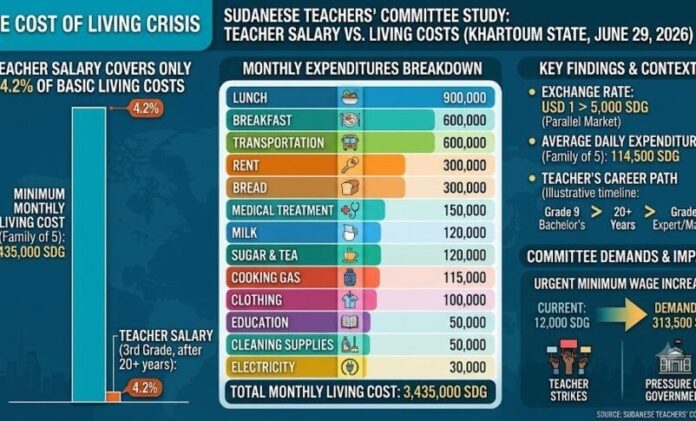
The Sudanese Teachers’ Committee concluded that the minimum monthly cost of living for a family of five in Khartoum State has reached 3,435,000 Sudanese pounds. Given this massive expenditure requirement, the study shows that even the salaries of high-ranking teachers with over 20 years of service remain critically low. Currently, a third-grade teacher’s salary can cover only 4.2% of these total living expenses.
This alarming standard of living was calculated based on the assumption that the family lives in a rented home and that the children attend public schools. The detailed study includes costs for food, transportation, rent, medical services, electricity, and cooking gas; it does not include any emergency or luxury expenditures.
The ongoing decline of the Sudanese pound in the black market has further exacerbated the economic crisis. At a time when the US dollar is trading for over 5,000 Sudanese pounds, government employees’ salaries have remained stagnant, failing to keep pace with rising costs.
According to the study’s data, the average daily expenditure for a five-member family is 114,500 Sudanese pounds. This means that lunch alone requires 900,000 pounds, breakfast 600,000 pounds, and transportation another 600,000 pounds per month. Other basic necessities, such as bread, medical costs, milk, sugar, tea, and cooking gas, demand millions more.
Due to these dire living conditions, the Sudanese Teachers’ Committee has officially requested that the minimum wage be increased from 12,000 Sudanese pounds to 313,500 pounds. However, as the government has yet to provide a satisfactory response regarding salary increases for employees, teachers in several parts of Sudan have gone on strike to demand their rights.
In Sudan, civil service grades begin at the 17th grade (for manual laborers) and extend up to the third grade. The third grade is reserved for professionals with a bachelor’s degree and extensive experience; a teacher is typically expected to serve for over two decades to reach this rank. Yet, even at this high professional level, the economic pressure makes it impossible to meet basic needs.
The Sudanese Teachers’ Committee has urged the government to honor the financial rights of its employees and take immediate steps toward salary reform to help the country emerge from this cost-of-living crisis.