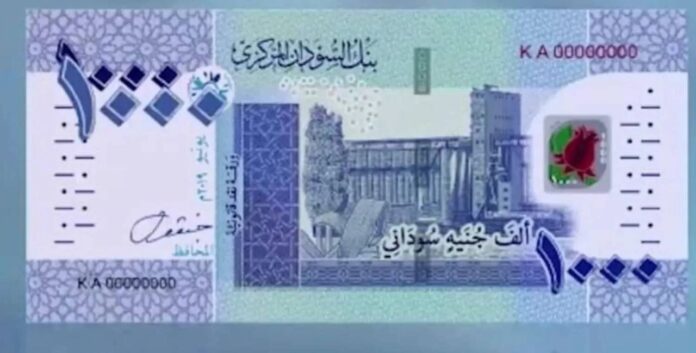
The division plaguing war-torn Sudan is no longer confined to geography, administration, and public services. In a deeply worrying escalation, the fracture has begun to tear at the fabric of one of the state’s most sensitive institutions: the financial system. Newly issued 1,000- and 500-pound banknotes, originally printed by the Central Bank of Sudan in May 2022, have been observed circulating heavily in regions controlled by the Rapid Support Forces (RSF).
The development has triggered intense debate over the future unity of the national currency and raised urgent questions regarding the official central bank’s ability to maintain authority over the country’s volatile cash supply.
The RSF-aligned parallel government, based out of Nyala, has officially authorized the circulation of these specific banknotes, which bear the signature of former Central Bank of Sudan governor Hussein Yahia Jangol. In a bold political maneuver, the parallel administration reappointed Jangol to his former post, placing him at the helm of what it refers to as its own central bank.
Conversely, the Nyala-based authorities have explicitly banned all other currency denominations bearing the signature of Burai al-Siddiq, the governor who succeeded Jangol at the official institution. Mohamed Hasan al-Taishi, prime minister of this parallel government, defended the actions by announcing a suite of monetary and banking policies aimed at constructing what he claims is an integrated, self-sufficient financial system.
The circulation of these notes outside official channels presents a severe risk to Sudan’s broader financial stability. Bankers and economists warn that the threat stems not from the physical banknotes themselves, but from the fracturing of the regulatory authority controlling their issuance.
A sovereign monetary policy depends entirely on a unified central bank’s capacity to manage the total money supply, regulate liquidity, ease pressure on the foreign exchange market, and control rampant inflation. When significant volumes of cash circulate entirely outside official state oversight, measuring monetary indicators becomes highly inaccurate, rendering national economic policies toothless and severely eroding public confidence in the Sudanese pound.
This institutional rift exacerbates a pre-existing structural crisis within Sudan’s cash-dependent economy. According to official data released by the Central Bank of Sudan, the nation’s money supply growth stood at a staggering 27.3% in April, reflecting the immense liquidity management hurdles brought on by more than three years of fierce civil conflict.
Compounding the issue, data from late last year indicated that currency held by the public accounted for an overwhelming 97.4% of the total cash in circulation, leaving a measly 2.6% within the commercial banking system. This extreme reliance on direct cash transactions heavily restricts the formal banking sector’s ability to mobilize domestic savings and feeds a massive informal economy that accounts for roughly 60% of Sudan’s overall economic activity.
While financial experts view the permanent establishment of two fully independent, formal banking systems as technically unlikely in the short term, they caution that a prolonged war could yield a fragmented reality similar to the Libyan or Somali models.
Without a central entity capable of managing foreign reserves, operating settlement systems, or maintaining relationships with foreign correspondent banks, Sudan may see the permanent expansion of informal, parallel financial networks to handle local trade and money transfers. Former Finance Minister Ibrahim Elbadawi noted that such deep economic distortions are the natural and expected consequences of a protracted civil conflict, emphasizing that the only true path to economic stabilization lies in a comprehensive political settlement rather than the continuation of a war where neither side can achieve a decisive victory.