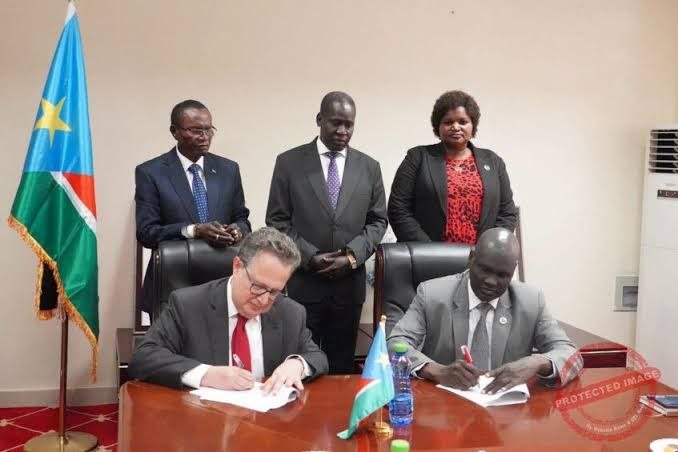
The United States and South Sudan’s Revitalized Transitional Government of National Unity (RTGoNU) have officially signed a landmark three-year bilateral health cooperation Memorandum of Understanding (MOU). Announced by State Department Spokesperson Thomas “Tommy” Pigott, the agreement is a direct implementation of the Trump Administration’s America First Global Health Strategy.
The initiative aims to dramatically scale up the global fight against infectious diseases, including HIV/AIDS, while simultaneously establishing robust defenses against emerging health crises, a move local officials state is particularly critical given the current threats posed by an active Ebola outbreak in the region.
Under the newly forged agreement, a total of more than $166 million will be injected into South Sudan’s healthcare landscape to combat pervasive health security threats. Working closely with Congress, the U.S. Department of State intends to provide more than $146 million dedicated to preventing the spread of infectious diseases across the country. In a significant departure from historical aid models, the RTGoNU has committed to co-invest nearly $20 million of its own public revenue directly into the South Sudanese health system.
This joint funding structure ensures that the local government takes an active, financial stake in managing self-sufficient health systems and delivering essential clinical care rather than relying solely on international donors.
The cornerstone of this specific MOU is the strict enforcement of mutual accountability and transparent reporting, ensuring that U.S. foreign assistance efficiently reaches its intended recipients without being diverted. To achieve this, the RTGoNU has legally committed to a series of jointly decided provisions, which include consistently paying its health sector workers’ salaries and properly maintaining vital infrastructure, such as cold chain systems for vaccine storage.
The U.S. Department of State has emphasized that it will protect American taxpayer dollars by evaluating the success of the program through rigid, jointly decided metrics. Furthermore, the framework mandates that South Sudan strengthen its capabilities for timely outbreak detection, requiring responses to potential infectious disease outbreaks within seven days of emergence to protect both South Sudanese and American citizens.
This diplomatic and humanitarian milestone in South Sudan reflects a much broader, sweeping restructuring of how American foreign medical aid is distributed globally under the America First framework. To date, the State Department has successfully negotiated and signed 33 bilateral global health MOUs with nations across Africa, Asia, and Latin America. This growing coalition includes Angola, Bolivia, Botswana, Burkina Faso, Burundi, Cambodia, Cameroon, Côte d’Ivoire, the Democratic Republic of the Congo, the Dominican Republic, El Salvador, Eswatini, Ethiopia, Guatemala, Guinea, Honduras, Kenya, Lesotho, Liberia, Madagascar, Malawi, Mozambique, Niger, Nigeria, Panama, Papua New Guinea, the Philippines, Rwanda, Senegal, Sierra Leone, South Sudan, Tajikistan, and Uganda.
Collectively, these 33 bilateral agreements represent a massive $20.8 billion in new global health funding, combining more than $12.9 billion in American assistance with over $7.8 billion in direct co-investments from the recipient countries themselves.
By securing these multi-billion-dollar commitments, the United States aims to build sustainably on decades of historical progress made against malaria, tuberculosis, HIV/AIDS, and other lethal pathogens. Officials express confidence that this localized, accountable approach will reshape the future of international health diplomacy, fostering self-reliance in developing nations while maximizing the impact of global health security measures.