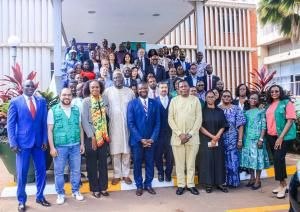
In a decisive bid to halt the regional spread of the Bundibugyo Ebola virus, top health leaders and policymakers from across the African continent have gathered in Uganda’s capital city. The high-level, three-day summit comes in direct response to the ongoing outbreak currently impacting both Uganda and the Democratic Republic of the Congo (DRC).
Co-organized by the World Health Organization (WHO) Regional Office for Africa, the Africa Centres for Disease Control and Prevention (Africa CDC), and the UK Health Security Agency, the emergency meeting aims to drastically scale up cross-border collaboration and forge a unified front against the highly contagious disease.
Delegates representing 11 high-risk nations have converged to rigorously evaluate and fortify their respective national defenses. Over the course of the meeting, participants are meticulously reviewing national preparedness evaluations, reviewing existing contingency plans, and pinpointing critical gaps in their current response frameworks.
A major focal point of the discussions centers on optimizing surveillance networks and tightening health security operations at high-traffic points of entry. Experts are emphasizing the need for stricter screening, swift triage, immediate isolation protocols, and seamless patient referral mechanisms across strategic airports, maritime ports, and bustling land border crossings.
To ensure these theoretical strategies hold up under pressure, the summit features intensive simulation exercises designed to stress-test multisectoral preparedness plans. These practical drills allow participating nations to safely identify operational vulnerabilities and refine their containment strategies before the virus breaches new territories.
Opening the convention, Uganda’s Director of Health Services, Dr. Charles Olaro, delivered a poignant reminder that isolated national efforts are entirely insufficient when dealing with a pathogen that respects no geopolitical boundaries. Dr. Olaro urged the delegation to candidly analyze what has worked in past interventions while aggressively funding research, treatment development, and cross-border coordination.
The financial reality hanging over the summit, however, remains stark and deeply concerning to global health officials. Dr. Marie Roseline Belizaire, the WHO Regional Emergency Director for Africa, revealed that the comprehensive continental preparedness and response plan jointly drafted by the WHO and Africa CDC requires upwards of $517 million to be fully realized.
Alarmingly, less than 15 percent of currently available resources are being channeled into preventative preparedness activities, with the vast majority of funds lagging behind active transmission. Dr. Belizaire warned that allowing the transmission to expand to additional nations would result in catastrophic financial, social, and economic costs, underscoring that pandemic preparedness is a fundamental pillar of national and economic security.
Echoing these urgent calls for institutional unity, Africa CDC representative Dr. Tolbert Nyenswah drew vital parallels to the devastating 2014–2016 West Africa Ebola epidemic. He reminded the assembly that the historical crisis was only brought under control once neighboring countries abandoned siloed approaches in favor of radical transparency and joint border management.
“Outbreak control cannot stop at national borders,” Dr. Nyenswah asserted, rallying the diverse coalition of attending nations—which includes Angola, Burundi, the Central African Republic, the Republic of Congo, Ethiopia, Kenya, Rwanda, Somalia, South Sudan, Tanzania, Zambia, and host nation Uganda. As the summit concludes, health experts remain hopeful that the actionable frameworks established in Kampala will catalyze faster detection and a resilient, synchronized health architecture capable of neutralizing the Ebola threat.