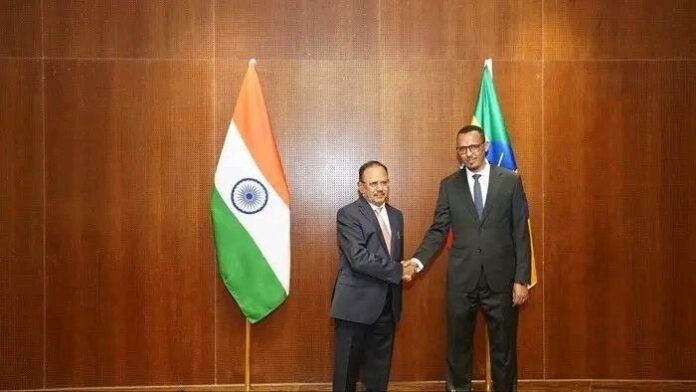
Senior intelligence and security officials from Ethiopia and India, meeting on the sidelines of the 16th BRICS National Security Advisers (NSAs) Meeting, have reaffirmed their commitment to further strengthening and expanding bilateral security cooperation. This meeting is viewed as a significant opportunity to elevate the strategic partnership between the two historic nations to a higher level.
According to a statement released by India’s Ministry of External Affairs, India’s National Security Adviser Ajit Doval held fruitful bilateral talks on Monday with Million Lema Tadesse, Executive Director of Analysis at Ethiopia’s National Intelligence and Security Service (NISS). The ministry noted that alongside his discussions with the Ethiopian delegation, Doval also held separate bilateral consultations with senior security officials from Brazil and South Africa.
The high-level discussions between India’s National Security Adviser and the senior leadership of Ethiopia’s NISS focused on avenues to bolster the multifaceted strategic partnership between the two nations. The two leaders deliberated on broad areas of cooperation aimed at mitigating shared security threats and enhancing regional stability. However, the ministry did not disclose further specific details regarding the exact security domains or agreements discussed during the session.
This high-level engagement in the security and intelligence sectors comes at a time when Addis Ababa and New Delhi are continuing to broaden their ties well beyond traditional diplomatic engagement. Currently, relations between the two countries are expanding rapidly in the fields of technology transfer, security cooperation, and human resource capacity building.
A series of agreements finalized between Ethiopia and India earlier this year underscores the deepening friendship between the two nations. On January 15, 2025, during a ceremony held at the Indian Embassy in Addis Ababa, the two countries signed an implementation agreement granting visa-free travel for holders of diplomatic passports. The agreement was signed by the Indian Ambassador to Ethiopia, Anil Kumar Rai, and Ethiopia’s Director General for Middle East, Asia, and Pacific Affairs, Ambassador Dewano Kedir. This accord is designed to streamline and facilitate official exchanges and high-level visits between the two states.
During the signing ceremony, Ambassador Anil Kumar Rai also reaffirmed India’s support for Ethiopia under the G20 Common Framework for Debt Treatment. This backing is expected to contribute significantly to Ethiopia’s ongoing economic reforms and financial stability efforts.
Furthermore, the two countries have advanced their cooperation in digital infrastructure from theory into practice. Demonstrating this progress, implementation has officially commenced on a memorandum of understanding to establish a state-of-the-art data center for Ethiopia’s Ministry of Foreign Affairs. This technological project is highly anticipated to boost Ethiopia’s diplomatic data management and cyber-security capabilities.