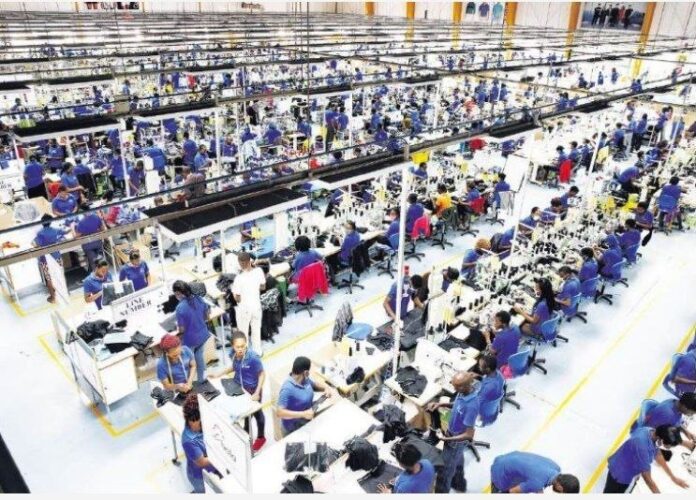
Following the rapid economic growth being witnessed in East Africa, Kenya has managed to consolidate its position as a leading economic power in the region. Recent data from the East African Community (EAC) for the first quarter of 2026 shows that the trade volume between East African nations and global markets has grown significantly, reaching a total of $46.3 billion (or 5.9 trillion Kenyan Shillings). This figure represents a 30.7 percent increase compared to the same period last year.
Kenya stands as the economic anchor of East Africa, holding 43.1 percent of the region’s economic share. Tanzania follows with 30.0 percent, and Uganda with 17.9 percent. Kenya has attained this status by serving as the region’s hub for logistics, finance, and manufacturing. While other regional states are engaged in exporting minerals and agricultural products, Kenya’s infrastructure and stable economic environment have made it the primary destination for trade in the region.
Unprecedented changes are occurring within the region’s trade sector. Copper has recently emerged as the region’s primary export commodity. Driven largely by production from the Democratic Republic of Congo, copper accounts for 44.8 percent of all exports. This is followed by precious metals and gemstones, which hold a 21.6 percent share. Traditional exports, such as coffee, tea, and spices, account for only 5.4 percent.
Although the trade volume between EAC countries and the world has increased, intra-EAC trade has declined by 10.4 percent. This suggests that East African nations are increasingly turning away from the region in favor of global markets, specifically China, the United Arab Emirates, and South Africa. China is currently the largest trading partner for the East African Community.
Regional nations have faced inflation challenges due to rising fuel and energy prices caused by international crises, such as the situation in the Middle East. However, compared to its neighbors, Kenya maintains better macroeconomic stability. Kenya’s annual inflation rate stabilized at 4.4 percent in March 2026, a figure significantly lower than those seen in Rwanda (8.8%), Burundi (10.6%), and South Sudan (27.9%). Tanzania recorded 3.2 percent inflation, while Uganda recorded the lowest at 2.8 percent.
The fact that total EAC trade is approaching the $50 billion mark shows that the region is playing an increasingly important role in global supply chains. However, experts note that for their economic development, regional states should not rely solely on global markets but must also fully utilize the potential of their Common Market. Given its macroeconomic policy and strategic location, the data indicates that Kenya will continue to remain the leader of the regional economy.