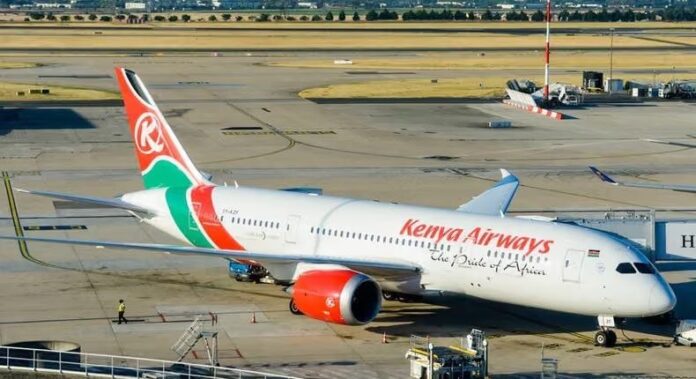
Kenya Airways has reported a staggering 72 percent surge in fuel costs during the first half of 2026, dealing a heavy blow to the national carrier’s recovery efforts. Airline executives attributed the drastic financial strain to the ongoing conflict in the Middle East, which has inflated global jet fuel prices and severely disrupted international aviation supply chains.
Beyond surging pump prices, the geopolitical crisis has triggered widespread delivery delays for critical aircraft spare parts and maintenance supplies. These bottlenecks have worsened pre-existing fleet constraints for an airline attempting to steady its operations. The latest financial shock arrives on the heels of a difficult 2025, where the carrier recorded a net loss of 17.2 billion Kenyan shillings (approximately $133 million). That previous deficit was largely driven by the temporary grounding of three Boeing 787-8 Dreamliners due to global engine and spare parts shortages, which slashed seat capacity by 18 percent and pulled annual revenue down to 161.5 billion shillings.
While Kenya Airways briefly returned to profit in 2024 for the first time in over a decade, successive operational headwinds have quickly erased those gains. The carrier had hoped to restore capacity and capture rising passenger demand throughout 2026, but persistent maintenance delays and high financing costs threaten to complicate these plans. Furthermore, the airline is actively seeking a strategic investor and attempting to raise at least $500 million to strengthen its balance sheet and expand its fleet.
The crisis highlights a deeper, systemic challenge facing African aviation as a whole. Fuel routinely represents the single largest operational expense for airlines, but the burden is disproportionately heavier on the continent. The International Air Transport Association projects that global jet fuel will average $152 per barrel in 2026—a nearly 70 percent jump from the 2025 average of $90. On top of high baseline prices, African carriers pay roughly 17 percent more for jet fuel than the global average due to constrained local refining capacity, heavy logistics expenses, regional taxes, and cross-border distribution hurdles. Consequently, fuel consumes between 30 and 40 percent of operating expenses for many airlines on the continent.
Regional carriers have also been forced to detour around volatile Middle Eastern airspace, resulting in extended flight paths and significantly higher fuel consumption on major routes linking Africa to Europe and Asia. Ironically, these airspace closures initially drove a surge in demand for Nairobi, as travelers bypassed Gulf transit hubs and pushed occupancy rates as high as 99 percent on select international routes earlier this year. However, the 72 percent spike in fuel expenses proves that higher passenger volumes do not automatically yield stronger profits when operating costs escalate uncontrollably.