African leaders held an urgent high-level presidential meeting following the Ebola Bundibugyo virus disease outbreak in the DRC and Uganda approaching a “critical operational tipping point”.
In a demonstration of continental unity and international solidarity, African Heads of State and Government, together with international health partners, held a Virtual High-Level Presidential Meeting (HLPM) to address the Ebola Bundibugyo virus disease (BVD) outbreak that is causing severe devastation in parts of the Democratic Republic of the Congo (DRC) and Uganda.
This high-level summit was chaired by Evariste Ndayishimiye, President of the Republic of Burundi and Chair of the African Union. The virtual meeting brought together an unprecedented coalition including the African Union Commission, Africa CDC, the United Nations, the World Health Organization (WHO), Regional Economic Communities, international financial institutions, philanthropies, and private sector leaders. Their sole and urgent objective is to contain the deadly outbreak at its source, protect frontline healthcare workers, and prevent a catastrophic regional spread.
According to data as of June 15, 2026, health authorities have recorded a total of 827 confirmed cases and 194 deaths across the two countries.
The Democratic Republic of the Congo bears the heaviest burden, reporting 808 confirmed cases and 192 deaths across the provinces of Ituri, North Kivu, and South Kivu. While Ituri remains the epicenter of the outbreak, North Kivu has become a major concern for epidemiologists due to daily increases in infections and a shocking estimated case fatality ratio of 64%. On the other hand, neighboring Uganda has recorded 19 confirmed cases and 2 deaths.
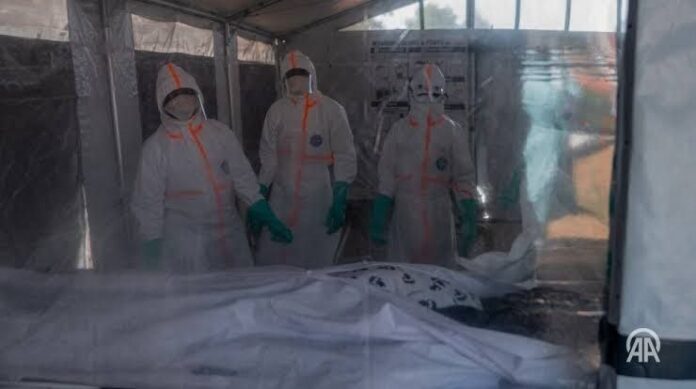
The leaders openly recognized that the outbreak response has reached a “critical operational tipping point”. Containment efforts are being severely hampered by a complex web of compounding problems, including high community transmission, suboptimal contact tracing, and rapid geographic expansion driven by high population mobility linked to mining activities.
Furthermore, deep-seated community mistrust, resistance to post-mortem testing, inadequate safe and dignified burial capacity, and infection prevention gaps have allowed the virus to slip through public health nets. Above all, the fact that no licensed BDBV-specific vaccine or therapeutic is available 19 years after the Bundibugyo ebolavirus was first identified has further exacerbated the crisis.
To address these compounding challenges, the summit resolved to request the urgent establishment of humanitarian access and response corridors, explicitly calling for “corridors of peace” in areas of active conflict. These corridors are described as vital for national authorities, Africa CDC, WHO, and UN OCHA to safely enter highly insecure and high-risk zones like North and South Kivu to deliver essential supplies, investigate alerts, and set up treatment facilities.
Additionally, the summit ordered an immediate and robust seven-day operational surge. This localized offensive will focus on strengthening case investigation, stabilizing daily data management, enforcing strict 21-day contact follow-up, expanding isolation capacity, and delivering personal protective equipment (PPE) to the frontlines.
The leaders emphasized that to break down the walls of mistrust, risk communication regarding the threat must be entirely led by trusted local community leaders.
The High-Level Presidential Meeting formally endorsed the comprehensive June-December 2026 joint response and preparedness plan, which requires an estimated budget of USD 518 million. International donors, partners, and member states have pledged USD 910 million to fight the outbreak. This includes USD 80 million from African Member States toward their self-imposed USD 100 million target.