

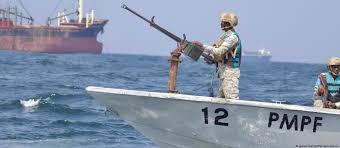
The global maritime industry is facing a severe security crisis as Somali piracy resurges in the Horn of Africa. This comeback, occurring alongside escalating conflicts in the Middle East, is disrupting international supply chains, driving up insurance premiums, and stretching global naval defense capabilities thin.
Over the past two months, the shipping sector has been navigating what captains describe as a “living nightmare.” With the Strait of Hormuz largely closed to commercial traffic and persistent attacks by Houthi rebels in the Red Sea, the traditional maritime artery connecting Asia and Europe has been severed. This geopolitical tension has forced nearly half of all westbound vessels to abandon the Suez Canal in favor of the lengthy detour around the Cape of Good Hope in South Africa.
To avoid missiles from Iran-backed groups, ships choosing the South African detour are forced to sail thousands of nautical miles directly along the Somali coast—the longest coastline in continental Africa. This 3,300-kilometer stretch was the epicenter of piracy during its violent peak in 2011. After a decade of relative calm, the threat has once again cast a shadow over these vital trade lanes.
In the past three weeks alone, three major vessels have been hijacked off the coasts of Somalia and neighboring Yemen. As of May 12, 2026, the oil tankers Honour 25 and Eureka, as well as the cargo ship Sward, remain under the control of pirates. Experts suggest that current regional instability has created a perfect environment for organized criminal syndicates to operate.
This new wave of piracy is not coincidental; it is a strategic exploitation of a security vacuum. International naval patrols, which had successfully suppressed piracy since 2008, are now distracted. Resources from the European Union’s Operation Atalanta and the multinational Combined Task Force (CTF 151) have been diverted to protect the Red Sea and the Strait of Hormuz, weakening the guard over Somali waters.
Tim Walker, a senior researcher at the Institute for Security Studies in South Africa, notes that pirate leaders, particularly in Puntland, perceive a lack of deterrence. “They are lying in wait to hijack ships and hold crews for ransom,” Walker stated. “While the world’s attention is fixed on the conflicts between Israel, Iran, and the United States, the pirates have found an open door.”
These groups are better funded and equipped with more modern weaponry than in previous years. According to Lloyd’s List Intelligence, pirates are now using “mother ships” (large hijacked vessels) to travel long distances, enabling them to attack commercial ships far from the coastline.
The convergence of the Hormuz closure, Red Sea instability, and Somali piracy has placed immense pressure on the economy. Detouring around Africa adds two to three weeks to travel time and results in up to $1 million in additional fuel costs per voyage.
During the 2011 crisis, the annual economic damage reached $7 billion. Currently, freight rates are soaring, and industry leaders warn that if piracy continues unabated, the global economy could face significant inflation.
Critics argue that changes in U.S. foreign policy have contributed to this problem. For years, development projects were implemented in Somali coastal communities to offer young men alternatives to crime. However, under the current Trump administration, non-security development aid has been largely suspended in favor of direct strikes against al-Shabab. This has weakened local intelligence networks that previously provided security information.
For now, maritime organizations are urging ships to stay far away from the Somali coast and to employ armed security teams. “A ship protected by an armed security team has never been successfully hijacked by pirates,” experts say. However, as long as the Middle East conflict persists, using the long sea route will remain a dangerous gamble for the world’s merchant fleet.