The international humanitarian response in Sudan stands on the precipice of total collapse, with relief operations facing imminent exhaustion within weeks as ongoing conflict, severe flooding, and catastrophic underfunding converge on millions of displaced civilians.
The International Organization for Migration (IOM) issued an urgent, high-level warning this week, cautioning that emergency relief supplies distributed through the vital Common Humanitarian Pipeline could run dry by the end of September 2026. Without an immediate injection of new financial backing from international donors, the foundational infrastructure supporting the nation’s aid network risks unraveling completely.
“We simply can’t turn our back on the people of Sudan when they need us most amid raging conflict, increased displacement, and the impact of heavy rain,” said Amy Pope, IOM Director General. “The entire humanitarian system could collapse within weeks if we don’t act now. Without new funding, we won’t be able to get help where it’s needed most.”
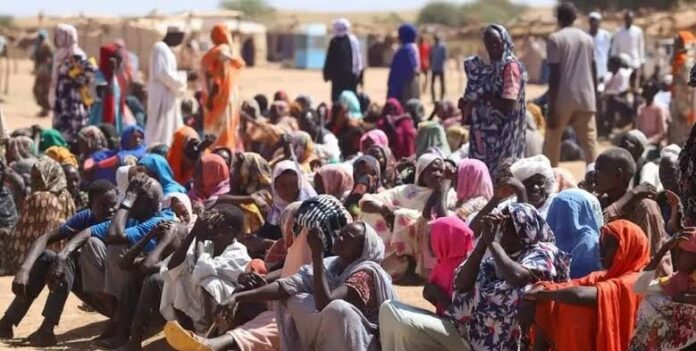
The looming breakdown threatens to strand millions of vulnerable individuals who depend on coordinated emergency assistance. According to IOM’s Displacement Tracking Matrix, Sudan currently accounts for an staggering 8.6 million internally displaced persons (IDPs), alongside 4.9 million recorded returnees. The crisis is further compounded by severe housing vulnerabilities, with nearly 70 percent of all internally displaced people forced to seek refuge within host families or makeshift informal settlements.
Compounding the displacement crisis, relentless seasonal heavy rains and destructive floods have repeatedly battered precarious shelters across the country, forcing already traumatized families into repeated cycles of secondary displacement. Prolonged exposure to extreme weather, environmental insecurity, and overcrowded living conditions have drastically elevated broader humanitarian protections risks, including heightened vulnerabilities to gender-based violence, forced evictions, and family separation.
At the center of the relief effort is the IOM-managed Common Humanitarian Pipeline, which functions as a vital shared logistics backbone for the United Nations and more than 100 registered humanitarian partners. By streamlining procurement, warehousing, and dispatch, the pipeline enables rapid, coordinated distribution of emergency shelter, sanitation facilities, and household relief items to communities cut off by conflict.
However, the pipeline’s operational capacity has shrunk dramatically in tandem with donor fatigue. While the system reached 2.84 million people following its expansion in July 2023, its annual reach has deteriorated steadily. More than one million people were assisted through the pipeline in 2024, dropping to 804,000 beneficiaries in 2025. Thus far in 2026, the IOM has managed to provide shelter and emergency support kits to only 330,000 people.
Current projections indicate that basic relief item stocks will be entirely depleted by the close of September 2026. Furthermore, the core warehousing and logistical operational capacities that sustain the pipeline can only be maintained through December 2026 if emergency funds fail to materialize.
Humanitarian officials emphasize that allowing the pipeline to collapse would carry catastrophic long-term consequences. Rebuilding the complex logistics network, supply chains, and partner coordination frameworks from scratch after any interruption would be an exceptionally costly, time-consuming, and resource-intensive endeavor, leaving a dangerous vacuum in Sudan’s aid architecture.
To avert a total breakdown, the IOM has outlined a tiered funding requirement depending on operational scale. The agency requires USD 15 million to sustain the Common Pipeline at its bare minimum 2026 capacity for 12 months, providing essential coverage for roughly 305,000 people. Restoring assistance closer to 2025 operational levels to reach 570,000 individuals requires USD 27 million, while a broader scale-up to deliver immediate, lifesaving support for up to one million people demands USD 42 million.