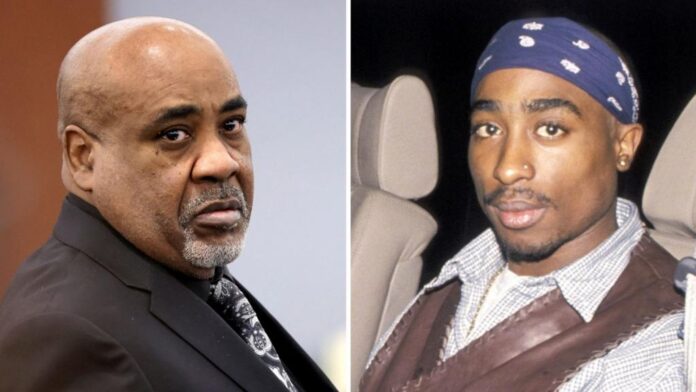
Duane “Keffe D” Davis, a former gang leader, has been found guilty of orchestrating the 1996 murder of rap icon Tupac Shakur, securing the first conviction in one of the most closely followed cold cases in American music history.
A Las Vegas jury found Davis, 63, guilty of one count of murder with a deadly weapon in connection with Shakur’s death in a drive-by shooting on September 7, 1996. Shakur was shot while travelling in a vehicle on the Las Vegas Strip and died six days later, on September 13, aged 25.
Davis, dressed in a black suit, stood silently as the verdict was read in Clark County District Court. He later told the court that he intended to appeal. Judge Carli Kierny scheduled sentencing for October 13.
Shakur’s relatives reacted emotionally to the verdict, holding hands, embracing and crying in the courtroom. Outside the courthouse, fans gathered to celebrate the conviction and remember the artist, whose music and public image helped define a generation of hip-hop.
Prosecutors argued that Davis did not pull the trigger but acted as the organiser of the attack. They told the jury that he ordered the shooting and supplied the weapon allegedly used by his nephew, Orlando Anderson, who was in the white Cadillac from which shots were fired.
The attack was allegedly planned in retaliation for a confrontation involving Anderson, Shakur and members of Shakur’s entourage at the MGM Grand Hotel in Las Vegas hours before the shooting.
At the time of Shakur’s death, hip-hop was shaped by high-profile rivalry between East Coast and West Coast artists and heightened tensions between the Bloods and Crips street gangs. Shakur had become closely identified with the West Coast scene and Death Row Records, adding to the public attention surrounding the case.
A central element of the prosecution’s case was Davis’s repeated public acknowledgement that he was in the Cadillac from which the shots were fired.
Davis had spoken to police in a confidential 2008 interview connected to the murder investigation of rapper Christopher Wallace, known as The Notorious B.I.G. He later discussed the case in documentaries, media interviews, podcasts and his 2019 memoir, Compton Street Legend.
Prosecutors argued that Davis’s public comments and book effectively nullified a prior agreement that had protected statements made during his police interview from criminal prosecution. The court ruled that the interview could be used as evidence in the murder trial.
In closing arguments, prosecutor Binu Palal told jurors that Davis had repeatedly presented himself as responsible for Shakur’s murder.
“He’s the shot caller,” Palal said, referring to Davis’s alleged leadership position in the South Side Compton Crips. “When you have the shot caller sitting shotgun when shots are fired, there’s no doubt he’s responsible.”
Davis’s defence team argued that the statements were not reliable and were made to promote his public profile and book sales. His lawyer, Michael Sanft, told jurors that Davis had exaggerated and fabricated parts of his story.
“There’s no proof,” Sanft told the court, urging the jury to treat Davis’s claims as boastful storytelling rather than admissions of guilt.
However, jurors reached a guilty verdict within hours of beginning deliberations.
The conviction brings a major development in a case that remained unresolved for nearly three decades, fuelling widespread speculation, documentaries, books and conspiracy theories.
Shakur, one of the most influential and commercially successful figures in hip-hop, sold more than 75 million records worldwide. His work addressed poverty, racism, violence, inequality, personal struggle and the realities of life in marginalised American communities.
With Davis now convicted, the case that became a symbol of hip-hop’s most enduring mysteries has entered a new legal chapter.