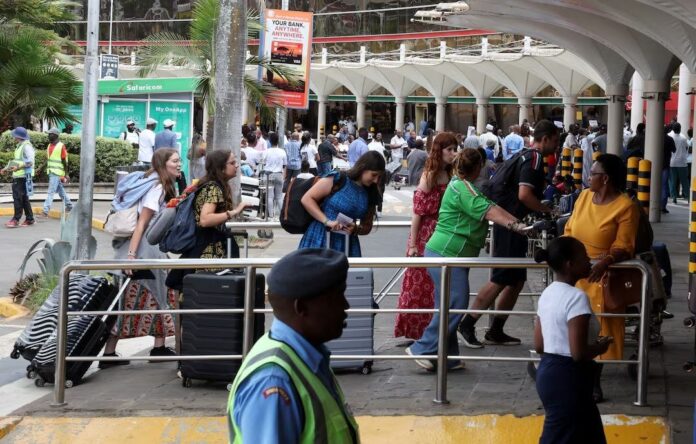
Thousands of travellers found themselves stranded at Jomo Kenyatta International Airport (JKIA) in Nairobi as a crippling go-slow strike by aviation workers entered its second consecutive day. The industrial action, spearheaded by the Kenya Aviation Workers’ Union (KAWU), has thrown flight schedules into disarray, forcing airlines to delay or cancel services and leaving passengers waiting indefinitely in terminal lounges.
The dispute stems from a litany of unresolved grievances between the union and key aviation stakeholders. KAWU has cited the failure to conclude a long-standing collective bargaining agreement with the Kenya Civil Aviation Authority (KCAA), alongside what the union describes as a frustrating lack of cooperation from the Kenya Airports Authority (KAA) and Kenya Airways subsidiary Jambojet. The breakdown in industrial relations has brought simmering workplace tensions to a head, directly impacting the operations of East Africa’s busiest aviation hub.
The ripple effects of the strike quickly spread across regional and international routes. RwandAir, Rwanda’s national carrier, announced via social media that it had been forced to cancel at least two flights due to acute air traffic control challenges stemming from the disruption at JKIA. Meanwhile, major domestic and international carriers experienced cascading delays as ground handling, check-in, and air traffic management operations slowed down significantly.
Passengers navigating the chaos shared stories of prolonged uncertainty and exhaustion. Rabbi Mendel Goldman, a traveller bound for a wedding in Florida, described spending nearly half a day at the airport without clear resolution.
“When I got here, the flight was delayed till 1 a.m. So it was an hour and a half delay, and then there was another delay till 4:30 a.m. And then at about 3 o’clock, I went to the check-in. They told me that the flight’s been cancelled,” Goldman said. “The earliest flight they can get us is only tomorrow night, so we’ve got to wait. We’re going to try and make most of it, but in the meantime, I’ve been here for 12 hours now, waiting in the airport.”
Official responses from airport management and regulatory bodies have been muted. While the KAA acknowledged on Sunday that certain flights were experiencing unusual delays, it refrained from publicly detailing the root causes and did not immediately respond to requests for comment as the strike stretched into Monday. Similarly, representatives from the Kenya Civil Aviation Authority and Jambojet remained silent amid mounting public frustration.
Despite the gridlock, there is a glimmer of hope for a negotiated settlement. KAWU Secretary General Moss Ndiema indicated that union leadership and government representatives held preliminary talks to bridge the divide, though Sunday’s discussions concluded without an immediate breakthrough.
“We have agreed to proceed with the engagements tomorrow, as from 11 o’clock in the morning. In the meantime, the strike action is still on,” Ndiema stated during a broadcast interview on KTN Television.
As delegations prepare to return to the negotiating table, thousands of stranded passengers and logistics operators continue to count the cost of the disruption, with the ultimate resolution resting on whether management and union leaders can finally reach a consensus on fair labor terms and institutional cooperation.