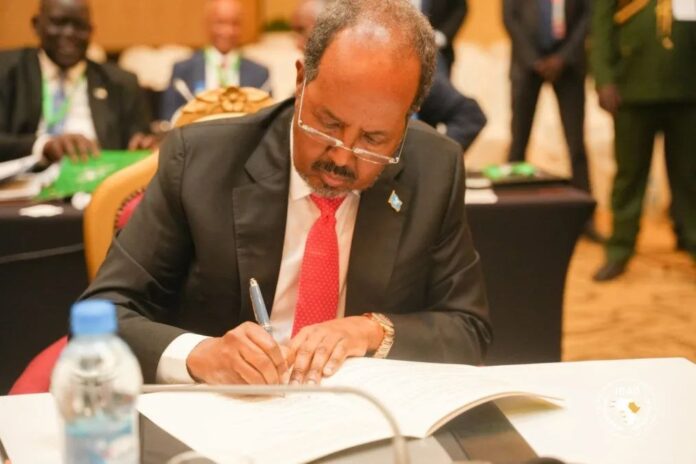
Somalia has formally completed its internal legal mechanisms to ratify the African Continental Free Trade Area (AfCFTA) agreement following presidential assent by President Hassan Sheikh Mohamud. The signing represents the culmination of a multi-stage legislative process, positioning the Horn of Africa nation to deposit its official instrument of ratification with the African Union Commission in Addis Ababa and become the 50th state party to fully accede to the trade accord.
The enactment follows parliamentary approval by the Federal Parliament, fulfilling the constitutional requirements necessary for international treaty adoption. By joining the flagship integration project of the African Union, Somalia enters a unified market spanning 54 nations, encompassing more than 1.4 billion consumers and a combined gross domestic product estimated at $3.4 trillion.
Government officials have described the ratification as a fundamental pillar of Somalia’s broader economic re-engagement strategy. Speaking on the policy objective, Commerce and Industry Minister Gamal M. Hassan stressed that the accord extends beyond conventional duty reductions, stating that it is not simply a trade agreement, but rather a strategic framework designed to catalyze industrialization, promote domestic value addition, attract foreign direct investment, and support sustainable economic expansion.
In response to the signing, the Ministry of Commerce and Industry has initiated operational planning to facilitate full alignment with AfCFTA guidelines. Key technical measures currently underway include formulating precise schedules to phase out custom duties on eligible goods, establishing robust rules of origin verification mechanisms to ensure local origin compliance, aligning national trade policies and quality controls with continental benchmarks, and actively partnering with commercial enterprises and agricultural cooperatives to raise awareness of preferential market opportunities.
Despite the expanding access to continental markets, trade economists highlight that systemic supply-side constraints remain Somalia’s primary economic bottleneck. The country’s existing trade balance reveals a pronounced structural deficit that tariff removal alone cannot address, evidenced by 2024 estimates showing total exports at roughly $448 million against imports of nearly $3.1 billion, leaving a massive trade deficit of approximately $2.65 billion driven by a heavy reliance on foreign consumer and capital goods.
Although Somalia holds membership in two other major Regional Economic Communities—the East African Community (EAC) and the Common Market for Eastern and Southern Africa (COMESA)—intra-African commerce still accounts for only a small fraction of overall national trade. The vast majority of domestic exports consist of unprocessed commodities, such as live animals, raw hides, bananas, and marine products, which are directed primarily toward Gulf Cooperation Council (GCC) states rather than neighboring African economies.
Analysts emphasize that expanding Somalia’s commercial footprint within the AfCFTA will depend heavily on targeted investments across key structural sectors. The country must transition from raw livestock and primary agriculture toward processed meat products, packaged marine items, and refined produce.
Achieving this shift will require developing cold-storage infrastructure to reduce post-harvest losses, strengthening national sanitary and phytosanitary regulatory bodies to secure continental compliance, and upgrading maritime ports, trade corridors, and border posts to lower overall logistics costs.
This historic ratification arrives at a critical juncture as Somalia advances its post-debt-relief financial strategy under the Heavily Indebted Poor Countries (HIPC) Initiative. As Mogadishu works to expand its blue economy and maritime commerce, the long-term utility of the AfCFTA will ultimately rely on the state’s capacity to build strong domestic industrial capabilities, diversify its export offerings, and successfully integrate local enterprises into continental value chains.