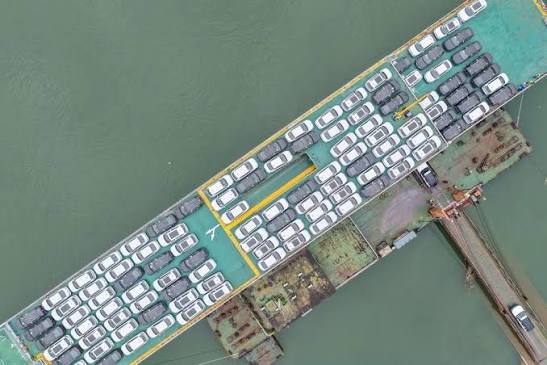
The renewed debate over China’s so-called excess capacity is about far more than industrial overproduction. It is, in essence, a contest over who gets to define fairness in a global economy that is increasingly shaped by geopolitics, protectionism and anxiety about shifting power. Beijing’s latest position paper on the issue argues that accusations against China are distorted, selective and often driven by political motives rather than economic logic. Whether one fully accepts that argument or not, the document exposes a deeper and more uncomfortable truth: the industrial order that once produced global growth is now under strain, and the language of “excess capacity” is becoming a weapon in that struggle.
At first glance, the term sounds technical and neutral. But in practice, it is highly political. When industrial powers complain that China is flooding world markets with cheap steel, electric vehicles, solar panels or batteries, they are not only describing trade flows. They are also defending domestic industries, protecting strategic sectors and trying to slow down a competitor that has become too successful for comfort. China’s response is predictable: it says its industrial rise is the product of innovation, large-scale production and deep integration into global supply chains, not artificial state support alone.
This is where the debate becomes complicated. Beijing is not wrong to point out that global manufacturing has never been static. Production has moved from Britain to the United States, from the West to Japan, then to East Asia and China, and now partly onward to Southeast Asia and other regions. That movement is a feature of globalization, not a defect. Industrial change always creates winners and losers, and every major wave of technological transformation has generated complaints about too much capacity in one place and too little in another. What feels like overcapacity from one capital often looks like competitiveness from another.
The problem is that the current controversy is not occurring in an era of trust. It is unfolding in a period of tariff wars, subsidy races and strategic decoupling. Western governments increasingly promote industrial policy when it suits their own needs while condemning similar behavior elsewhere. They subsidize green industries, semiconductor production and advanced manufacturing at home, yet accuse China of distorting markets when its firms do what global firms have always done: scale up, cut costs and capture market share. That double standard weakens the moral authority of the criticism.
Still, China’s defense should not be accepted uncritically. The fact that industrial competition is normal does not mean all market distortions are imaginary. Large subsidies, opaque support systems and state-backed expansion can affect prices, investment decisions and trade balances. For countries trying to rebuild industry after years of deindustrialization, the arrival of cheaper imports can feel less like competition and more like suffocation. That concern is especially acute in the developing world, where industrial policy space is limited and local firms often cannot survive prolonged exposure to subsidized global giants. The challenge, then, is not to deny excess capacity debates outright, but to place them within a fairer and more transparent framework.
China’s argument that trade surpluses do not automatically mean excess capacity is also economically reasonable. A country can run a surplus because of savings patterns, exchange rates, industrial specialization or global demand for its products. Surplus alone is not evidence of wrongdoing. Germany and Japan have long been trade surpluses economies, and no serious analyst would describe every export success as proof of systemic imbalance. The same logic should apply to China.
If its exports of electric vehicles, batteries and solar panels are booming, that may reflect global demand for affordable green technology as much as any domestic policy.
Yet Beijing’s own language reveals the strategic stakes. The document repeatedly frames China not as a threat but as “China opportunity 2.0,” presenting its industrial rise as a benefit to the world. That is a smart political move, because it shifts the conversation away from confrontation and toward shared gains. There is some truth in it. Chinese manufacturing has lowered the cost of goods, accelerated the spread of clean energy technologies and helped many developing countries access industrial equipment they could not otherwise afford. For Africa, Asia and Latin America, this has often been a practical advantage, not a theoretical one.
But opportunity does not erase dependence. A world economy that relies too heavily on one industrial powerhouse is vulnerable to shocks, policy shifts and supply disruptions. That is why the answer to China’s rise should not be simple resistance or blind acceptance. It should be diversification, stronger domestic production capacity and smarter regional cooperation. African countries, in particular, should read this debate carefully. The question is not whether China is too strong; it is whether African economies are building enough industrial depth to engage China on better terms. If not, the continent risks remaining a passive consumer of finished goods rather than an active participant in the next phase of manufacturing.
This matters for trade policy in the Horn of Africa and beyond. Countries in the region need investment in energy, logistics, transport and industrial parks that can turn trade into transformation. If Chinese capital helps build roads, factories and power networks, that is welcome. But if imports simply crowd out local production without building local capability, then the long-term gains will be limited. The same debate over “capacity” should therefore be used by African policymakers to ask a harder question: which industrial partnerships create value at home, and which only deepen dependency?
In the end, the excess capacity debate is less about one country than about the future of globalization itself. If the world is moving toward fragmentation, then industrial policy will increasingly be judged not by efficiency alone but by strategic loyalty. If the world still wants openness, then countries must accept that competition produces winners and losers, and that success in trade cannot always be separated from political discomfort. China’s position paper is a forceful reminder that economic disputes are now being fought with ideological tools. The real test is whether the rest of the world can respond with principles rather than slogans.
A healthier global economy would not treat every export success as a threat, nor every subsidy as a scandal. It would demand transparency, enforce fair rules and leave enough space for development at different stages. That is the standard worth defending. China may be right that the excess capacity narrative is often abused. But the deeper issue is not whether the label is fair. It is whether the international system can still manage industrial rivalry without turning cooperation into permanent confrontation.