Ethiopia possesses enough natural energy potential to power a continent, its own citizens remain overwhelmingly in the dark. The data shows that despite heavy state investments in macro-infrastructure over the past decade, half of the Ethiopian population still completely lacks access to reliable electricity. This crippling energy deficit dampens industrial growth, chokes job creation, and severely hinders small-business development across the country.
The true tragedy of Ethiopia’s power sector lies in its immense, untapped natural wealth. The country is sitting on a goldmine of renewable energy resources, with a projected capacity to generate more than 60,000 MW from a clean mix of hydropower, wind, solar, and geothermal sources. Currently, about 90% of the nation’s operational power is derived from hydro. Yet, translating this immense green potential into actual, flickering light bulbs at home has proven to be a massive bottleneck, with Ethiopia producing just 9,761 MW today, which is less than one-sixth of its total capability.
To close this massive gap, the government completed construction on the Grand Ethiopian Renaissance Dam (GERD) in 2022. This U.S. $5 billion mega-project, which stands as Africa’s largest hydroelectric plant, successfully concluded its final reservoir filling in September 2023 and is slated to eventually provide over 5,000 MW of electricity. However, the project has triggered deep geopolitical friction with downstream neighbors Egypt and Sudan over water security on the Nile, all while placing an enormous financial burden on the state. Furthermore, as of recent tracking, Ethiopia had completed only 30% of its overall energy-development plan, hindered by structural barriers including the state’s strict monopoly on power generation, severe financing deficits, and inadequate maintenance systems that lead to frequent technical failures at existing power plants.
For the average citizen, the physical existence of a power grid is purely an illusion. Afrobarometer’s face-to-face survey of 2,400 adult citizens found that while exactly half (50%) of all Ethiopians live in areas technically served by an electricity grid—a notable jump from 32% in 2020—only 43% are actually connected to it. High upfront expenses like connection fees, mandatory inspection costs, and house wiring make grid access financially prohibitive for millions. Out of 39 African nations surveyed by Afrobarometer, only nine countries recorded lower rates of grid access than Ethiopia, underscoring a severe regional developmental lag.
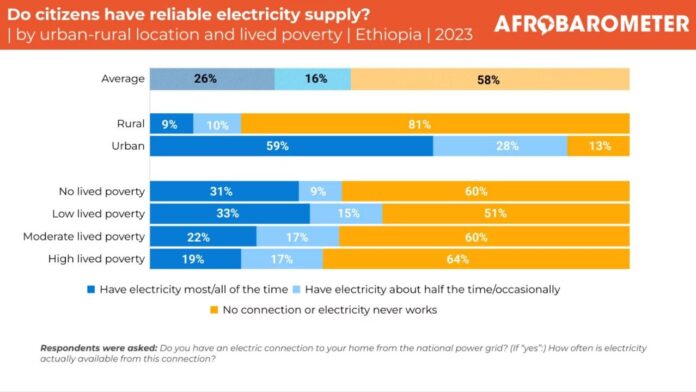
This disparity between urban centers and the rural majority is stark and troubling. While a staggering 93% of urban residents live within reach of the grid and 88% are connected, the reality in the countryside is a complete inversion, with just 28% of rural communities having physical grid infrastructure nearby and a meager 20% of rural households hooked up to the power lines. Connection rates also correlate heavily with formal schooling, showing that only 22% of adults with no formal education have electricity at home compared to 81% of those with post-secondary education. Furthermore, connection does not guarantee a steady supply; across the country, only 26% of all citizens enjoy electricity that functions “most” or “all” of the time, and in rural areas, that number drops to a dismal 9%, leaving more than nine out of ten rural citizens without dependable power.
This persistent lack of dependable power has forced electricity to become a top national priority for ordinary citizens. One in five Ethiopians (20%) now names electricity provision as one of the top three critical problems the government must address, placing the energy crisis on equal footing with the country’s civil war as a core national concern. Under this framework, public management of the economy remains the top priority at 47%, followed by water supply at 25%, infrastructure and roads at 23%, unemployment at 18%, and both electricity and civil war tied in fourth place.
Public sentiment regarding state performance reflects deep frustration, as nearly two-thirds of the population (64%) rate the current government’s handling of electricity provision as “fairly badly” or “very badly”. Disapproval peaks sharply among the most vulnerable, with 73% of rural dwellers, 75% of senior citizens, and 75% of the poorest respondents giving the state a failing grade. The survey findings highlight a critical policy crossroad: while centralized mega-projects like the GERD represent long-term developmental milestones, they cannot fix last-mile distribution failures on their own. Until the government addresses state monopolies, scales up distribution financing, and prioritizes rural grid equity, Ethiopia’s massive renewable potential will remain trapped in a paradox—and millions of its people will remain in the dark.