The Government of South Sudan has announced a comprehensive plan to expand veterinary services nationwide. The initiative aims to unlock the vast, untapped potential of the country’s livestock sector, bolster food security, and stimulate domestic and regional economic growth.
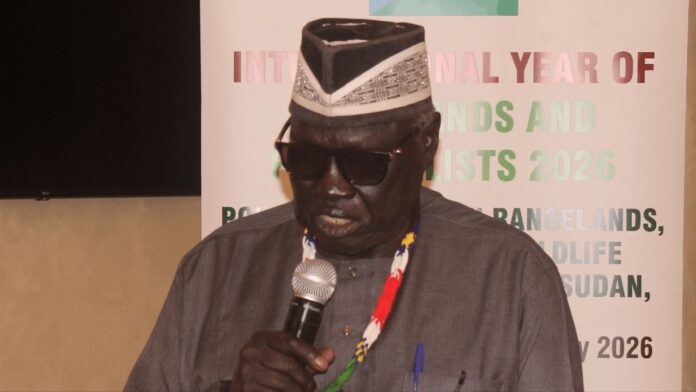
Speaking during a high-level, two-day national dialogue on rangelands, pastoralism, and wildlife conservation in the capital, Juba, the Minister of Livestock and Fisheries, Onyoti Adigo Nyikwec, outlined the government’s vision. He emphasized that establishing a robust animal health infrastructure is a fundamental prerequisite for boosting livestock productivity and gaining access to highly competitive international and regional trade markets.
According to Minister Adigo, the modernization efforts will extend far beyond basic animal care, serving as a pillar for both economic development and social stability. He identified several key pillars of the government’s upcoming approach, which includes integrating animal health systems with broader rural community support to ensure holistic development, and scaling up livestock processing industries, improving local market structures, and facilitating smoother regional trade.
Furthermore, the plan places a heavy focus on investing in women and youth by dedicating resources to research, innovation, and skills development, alongside promoting peace-building through the equitable and fair distribution of vital natural resources like water and grazing land.
Minister Adigo stated that these priorities are investments not only in agriculture but also in peace, resilient employment, and national prosperity. He urged broad collaboration from the private sector, financial institutions, civil society, and research bodies to turn this vision into a reality.
To bring these plans to fruition, South Sudan is utilizing World Bank funding to implement the Livestock Sector Resilient Project. This project specifically targets the intersection of animal health and sustainable land management across the country.
Additionally, the ministry has formulated a comprehensive National Resource Sector Strategy, which is currently awaiting official validation. This policy framework is designed to restore degraded ecosystems, promote climate-smart landscape management, and streamline natural resource governance.
One of the most anticipated tactical moves within this strategy is the formal creation of designated livestock migration corridors. These corridors are intended to guide pastoralists away from agricultural areas, effectively mitigating the recurring, often violent, clashes between herders and farming communities over land and water.
The Food and Agriculture Organization (FAO) of the United Nations has thrown its strong support behind the government’s plans. Felix Dzvurumi, the FAO Representative in South Sudan, advocated for greater recognition of, and responsible investment in, traditional pastoralist systems. Dzvurumi noted that outside of major urban hubs like Juba, formal banking infrastructure is virtually non-existent, leaving rural populations to rely heavily on their herds as a primary store of value.
Within this context, livestock serves multiple critical roles, functioning as a decentralized banking system for rural households while directly providing milk, meat, and vital daily sustenance. The herds also act as a crucial resilience buffer, serving as emergency collateral and savings during climate or economic crises, while simultaneously driving active local markets and regional cross-border trade, notably in the greater Kapoeta area.
Felix Dzvurumi remarked that in South Sudan, pastoralism is deeply connected to identity, culture, economy, and survival, stressing that sustainable development in this sector is the ultimate foundation for community resilience in times of crisis.