The government of South Sudan has announced a major policy shift toward regional trade integration and economic diversification. Senior policymakers and business leaders made the declarations during the Second National Trade Forum in Juba, emphasizing the urgent need to unlock the nation’s untapped agricultural and manufacturing potential.
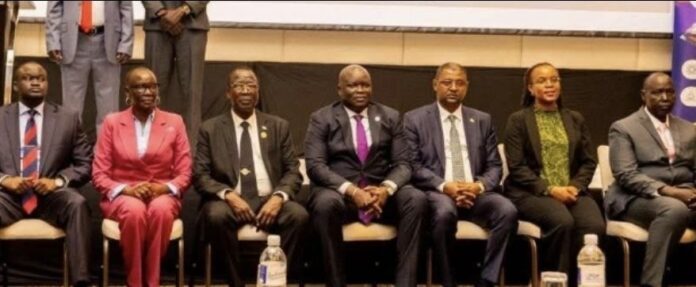
The high-level, two-day forum—convened by the Ministry of Trade and Industry in partnership with TradeMark Africa—was held at Juba’s Radisson Blu Hotel under the theme: “From Potential to Prosperity: Harnessing South Sudan’s Competitiveness for Regional Trade Integration.”
Opening the forum, East African Community (EAC) Affairs Minister Pieng Deng Kuol delivered a sobering assessment of the nation’s economic landscape. He noted that despite possessing vast tracts of arable land, immense water resources, and substantial oil reserves, South Sudan has consistently failed to convert its natural wealth into tangible economic benefits for its citizens.
“We have potential in everything,” Minister Kuol told attending delegates. “We have natural resources, but our people are not benefiting from them.”
More than a decade after gaining independence, South Sudan remains largely invisible in regional markets. Crude oil continues to dominate its minimal export portfolio, while the country relies entirely on imports for manufactured goods, consumer products, and ironically, refined petroleum.
Kuol pointed out that South Sudan is failing to compete within the EAC bloc, which it joined in 2016 as its sixth member. He advocated for immediate industrial upgrades, questioning why the nation continues to export raw crude rather than investing in domestic refineries. Establishing local refining capacity, he argued, would allow South Sudan to command a dominant and highly profitable position in the regional market.
Trade and Industry Minister Labanya Margaret Mathya Ugila echoed these sentiments, challenging stakeholders to abandon outdated economic frameworks. She urged a cultural shift away from merely “pushing” development projects toward actively creating an ecosystem that attracts foreign investment, trade, and sustainable growth. Minister Ugila described the forum as a vital mechanism for identifying actionable, real-world solutions to South Sudan’s structural economic challenges.
The gathering drew a diverse group of government officials, domestic traders, international investors, development partners, and representatives from neighboring East African nations. The primary agenda focused on eliminating trade barriers, accelerating industrialization, and deepening integration into the regional economy.
The call for diversification has taken on a new sense of urgency. Currently, oil sales account for more than 90 percent of government revenues. This extreme reliance on a single commodity leaves the South Sudanese economy highly vulnerable to volatile global oil prices and severe geopolitical disruptions—particularly along critical export pipelines running through neighboring Sudan.
Years of conflict, structural insecurity, weak infrastructure, and negligible industrial capacity have severely constrained broader economic growth. Though the country boasts millions of hectares of fertile land, it still imports massive quantities of food from regional neighbors like Kenya and Uganda, skewing trade volumes heavily toward imports.