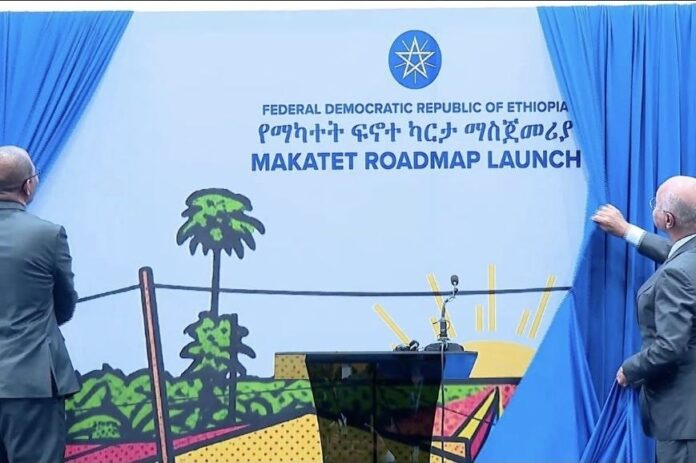
Ethiopia has unveiled the Makatet Roadmap, a comprehensive national framework designed to integrate refugees into local development systems while advancing shared economic and social outcomes for host communities. The initiative is being framed as a model for localized development and a test case for more equitable international responsibility sharing.
Speaking at the launch, the United Nations High Commissioner for Refugees praised Ethiopia’s approach as a significant shift in global refugee policy. He noted that the country has demonstrated how refugee protection and national development can progress in tandem, rather than as parallel or competing agendas.
“The Makatet Roadmap serves as a blueprint for translating that vision into practical action,” he said, adding that it aims to expand opportunities for refugees while strengthening resilience among host communities. The framework aligns with UNHCR’s “50 by 35” vision, which seeks to reduce aid dependency by enabling refugees in protracted situations to achieve greater self-reliance and access long-term solutions over the next decade.
He emphasized that sustained international support will be critical, underscoring UNHCR’s commitment to mobilizing resources and reinforcing global solidarity to support Ethiopia’s efforts.
The launch event culminated in a strong political endorsement from Ethiopia’s Speaker of the House of People’s Representatives, Tagesse Chaffo, who reaffirmed the government’s commitment to implementing area-based inclusion across refugee-hosting regions.
“The Makatet Roadmap is not merely a policy document; it is a binding strategy for inclusion and development,” he said. “Through coordinated, area-based planning, we aim to strengthen national systems to deliver protection, opportunity and a better future for both refugees and the communities that host them.”
The roadmap brings together legal reforms, policy frameworks and localized planning mechanisms into a unified strategy. By embedding refugee inclusion within national systems—ranging from service delivery to economic participation—the initiative seeks to move beyond short-term humanitarian responses toward sustainable development solutions.
Analysts view the Makatet Roadmap as part of a broader shift in global refugee governance, where frontline states like Ethiopia are increasingly advocating for development-oriented approaches backed by predictable international financing and responsibility sharing.
If effectively implemented and supported, the initiative could serve as a global reference point for countries hosting large refugee populations, particularly in regions where displacement is protracted and resources remain constrained.