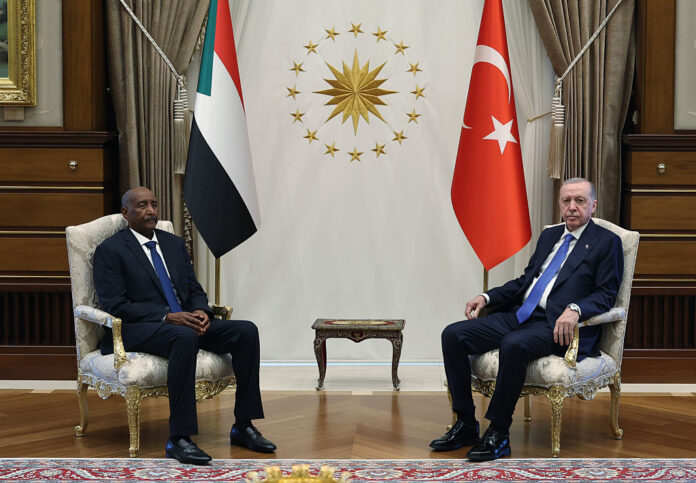
Turkish President Recep Tayyip Erdogan has welcomed Sudan’s army chief, General Abdel Fattah al-Burhan, at the Presidential Complex in Ankara. This visit takes place at a time when Turkish-made unmanned aerial vehicles (drones) and other military hardware have come to play a central role in the military campaigns of the Sudanese Armed Forces (SAF).
The two leaders discussed bilateral relations and current regional issues in depth, with Erdogan stating that efforts are underway to further enhance the already close cooperation in the fields of trade, agriculture, energy, and defense. The Turkish president framed Ankara’s involvement in the Sudanese civil war—which has been ravaging the country since April 2023—as being driven by a “desire to halt the bloodshed and preserve Sudan’s territorial integrity.” Sudanese state media similarly emphasized that the meeting in Ankara aimed to design “mechanisms to further develop” ties between the two countries.
However, while Ankara presents itself as a supporter of Sudan’s sovereignty and peace efforts, analysts point out that the acquisition of Turkish-made ‘Bayraktar TB2’ drones and other military systems by the Sudanese army is causing severe harm to civilians and undermining Western sanctions as well as peace mediation efforts. Although no new defense pact has been officially announced following the visit, Turkey’s military footprint has become deeply entrenched in the war between the SAF and the Rapid Support Forces (RSF) through consecutive arms sales, training, and technical support.
Documents published by the Washington Post in March 2025 revealed that the Turkish defense company Baykar, the manufacturer of the Bayraktar drones, covertly funneled about $120 million worth of weapons shipments to the Sudanese army. This cargo included at least eight TB2 drones, ground control stations, and hundreds of guided munitions. Analysts say these drone systems proved decisive in allowing the Sudanese army to force the Rapid Support Forces (RSF) out of the capital, Khartoum, and other strategic hubs in 2025, bringing a major shift to the balance of power on the frontlines.
Recently, researchers also pointed out that Turkish drones played a direct role in the battle to lift the siege on the town of Dilling in South Kordofan, a conflict that forced thousands of civilians to flee. The Sudanese army expanded its reliance on drones partly in response to the RSF’s own deployment of unmanned aircraft, which are believed to be supplied and supported by the United Arab Emirates (UAE).
Despite active arms embargoes imposed on Sudan by the United Nations, the European Union, and the United States, weapons transfers by both Ankara and Abu Dhabi have continued. This has raised concerns over how Turkey, a NATO member, is bypassing international restrictions through opaque financial channels and third-country transshipment hubs. United Nations expert reports and investigations have pointed to military cargo flights moving from Istanbul to Port Sudan.
Meanwhile, the toll of this drone warfare on Sudanese civilians has reached devastating levels. According to UN data released in May 2026, drones were responsible for more than 80 percent of recorded civilian deaths during the first four months of the year alone, killing at least 880 people. UN High Commissioner for Human Rights Volker Türk condemned the escalating use of armed drones by all parties, warning that this trajectory could push the conflict into an even deadlier phase.