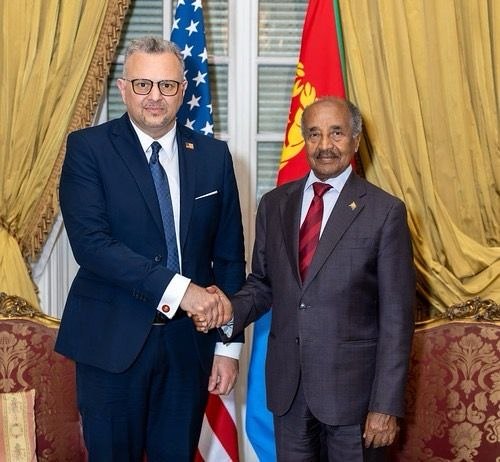
The United States and Eritrea have renewed their commitment to constructive, multifaceted engagement, focusing on bilateral relations and regional stability in the Horn of Africa and the Red Sea. This commitment was reaffirmed during a meeting held on the sidelines of the 80th session of the United Nations General Assembly in New York, between Eritrean Foreign Minister Osman Saleh and U.S. Senior Advisor for African and Arab Affairs, Massad Fares Boulos.
Described as “good and productive,” this meeting is seen as potentially marking a new chapter in a relationship long characterized by tension and suspicion.
Although the United States recognized Eritrea’s independence in 1993, their relationship remained strained for decades. The U.S. State Department previously imposed sanctions and contributed to Eritrea’s isolation, citing concerns over its human rights record, lack of democratic institutions, and involvement in regional conflicts.
For its part, Eritrea has viewed U.S. regional policy with deep suspicion, prioritizing its sovereignty and non-interference in its internal affairs above all else.
However, recent geopolitical shifts have forced a reassessment on both sides. The security of the Red Sea, vital to global trade, has become a focal point of strategic competition. Because the region is one of the most strategically significant in contemporary international politics, it has attracted the attention of numerous global and regional powers.
The growing influence of countries such as Iran, Turkey, the United Arab Emirates, and China has compelled Washington to adjust its approach, while simultaneously increasing the value of Eritrea’s strategic location.
Washington’s stance toward Asmara is gradually shifting from a strategy of isolation to a practical approach focused on Red Sea security and regional dynamics.
The U.S. seeks to leverage Eritrea’s position to address maritime tensions and threats, while Asmara hopes to overcome its isolation by engaging with American goodwill. This was evidenced by a letter sent in July 2025 from U.S. President Donald Trump to Eritrean President Isaias Afwerki, expressing readiness to re-establish a productive relationship.
High-level meetings, including those held in New York and Cairo, have further accelerated this process.
This rapprochement is increasingly being viewed as part of a broader realignment in the Horn of Africa. Egypt, Eritrea, and Somalia have formed a coordinated front regarding Red Sea governance and regional security. Following the diplomatic friction triggered by Ethiopia’s 2024 memorandum of understanding with Somaliland, these nations have been steadily strengthening their strategic coordination.
The stance of the three countries is that the security and governance of the Red Sea are the exclusive right of the coastal states, an position widely interpreted as a rejection of Ethiopia’s quest for sovereign maritime access. The U.S. is now working with all three partners, signaling an understanding that engaging with this new alignment is necessary to ensure stability in the Red Sea.
The meeting in New York was attended by Eritrea’s Permanent Representative to the UN, Ambassador Sophia Tesfamariam, and the Charge d’Affaires at the Eritrean Embassy, Mr. Berhane Gebrehiwet. Both sides agreed to continue exchanges in the coming months to renew their bilateral relations.
Foreign Minister Osman Saleh, who has served as Eritrea’s top diplomat since April 2007, is a key figure in this process. He played a crucial role in the 2018 peace process with Ethiopia and has represented Eritrea’s position on regional and international platforms for nearly two decades.
The Eritrean Ministry of Information has expressed appreciation for the U.S. willingness to consider lifting sanctions, while condemning efforts by Moscow and Beijing to impose sanctions on Asmara through the UN Security Council. This rapprochement between Asmara and Washington reflects a policy shift by Eritrea, occurring at a time when it feels its traditional allies have failed to provide sufficient support.
Although this new chapter is promising, the relationship is not without challenges. A crisis of trust persists between the two sides; Washington continues to view Eritrea as a “difficult partner,” while Asmara remains wary of Western intentions.
Furthermore, the personalization of Eritrean politics under President Isaias Afwerki has posed obstacles to establishing stable institutional relations. Nevertheless, the current geopolitical environment has opened a window for limited, practical cooperation on shared strategic priorities.
The meeting of U.S., Egyptian, Eritrean, and Somali diplomats in Cairo in July 2026 showcased this increasingly coordinated regional alignment. The meetings signaled Washington’s interest in engaging with the countries that play key roles in the politics of the Horn of Africa—ranging from Red Sea security to the conflict in Sudan.
The U.S.-Eritrea rapprochement has the potential to cause a significant shift in the Horn of Africa, with the capacity to rebalance regional power and forge new alliances in the Red Sea area. While the path remains cautious and tested by the complexities of the region, both nations appear committed to continuing the constructive dialogue that aids regional peace and stability.