Lome, Togo
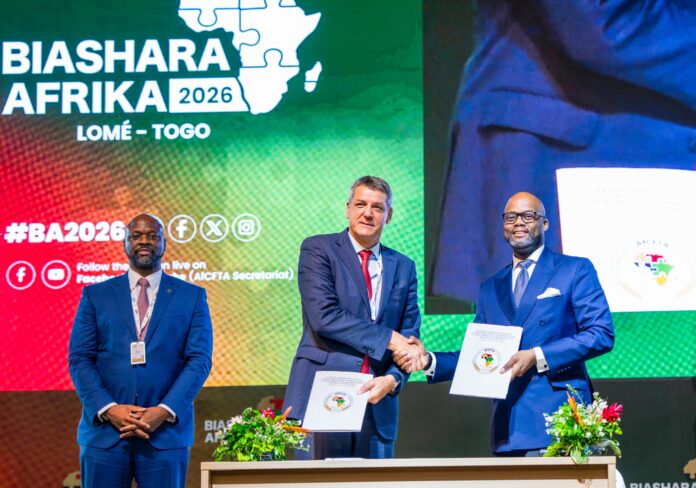
The Secretariat of the African Continental Free Trade Area (AfCFTA) has entered into a strategic partnership agreement with Rendeavour, Africa’s largest new city developer. This historic agreement is primarily aimed at accelerating the implementation of the continental free trade agreement through infrastructure-led industrialization, building integrated economic zones, and expanding trade-enabling urban developments.
This partnership, signed on the sidelines of the prestigious Biashara Afrika 2026 business forum, seeks to strengthen Africa’s industrial capacity by promoting Special Economic Zones (SEZs). Furthermore, mobilizing private capital for critical regional connectivity infrastructure and supporting the development of trade and industrial corridors linked to master-planned cities and logistics networks are core components of the collaboration.
Biashara Afrika is the AfCFTA Secretariat’s flagship platform for engaging with private sector investors, and the 2026 summit brought together heads of state, ministers, regulators, investors, and business community leaders. The summit featured extensive discussions on industrial development, the growth of intra-African trade, and private sector-led economic growth under the continental trade pact framework.
Under the agreement, Rendeavour will work closely with the AfCFTA Secretariat across three major priority areas. The first is advancing the role of Special Economic Zones (SEZs) as engines of industrialization to boost manufacturing capacity. The second is attracting private investment by mobilizing capital from both domestic and foreign private investors for critical infrastructure that directly supports trade. The third is fostering industrial corridors by creating trade routes and logistics networks connected to integrated modern urban developments across Africa.
This partnership comes into effect as Africa seeks to unlock the full potential of the AfCFTA, which covers a market of more than 1.4 billion people with a combined gross domestic product (GDP) exceeding $3.4 trillion. Studies indicate that when this trade agreement is fully implemented, it is projected to generate an additional $450 billion in income across the continent by 2035.
Despite the grand promise of a single African market, intra-African trade currently remains at a very low level. At present, trade among African countries accounts for only about 14 percent of the continent’s total trade volume. Additionally, Africa hosts just 230 of the world’s more than 5,400 Special Economic Zones, a figure that clearly highlights the continent’s massive infrastructure and industrialization gap.
Industry stakeholders argue that bridging this wide gap will require large-scale investment in physical infrastructure. This includes building industrial parks, logistics corridors, reliable utility supplies like water and electricity, and modern mixed-use developments capable of supporting businesses, workers, and expanding urban economies.
Stephen Jennings, the founder and chief executive officer of Rendeavour, stated that his company is positioning itself as a key private sector implementation partner for the AfCFTA. Jennings noted that Africa is not only currently the fastest-growing region in the world, but over time, it will also become one of the safest and most reliable destinations for investment. He added that as the first private sector implementation partner of AfCFTA, Rendeavour’s cities are recognized for having reliable infrastructure and favorable operating environments where investment, manufacturing, and trade can highly thrive.
Backed by investors from the United States, Norway, New Zealand, and the United Kingdom, Rendeavour has developed large-scale urban projects in Nigeria, Kenya, Ghana, Zambia, and the Democratic Republic of Congo. The company’s investment portfolio includes industrial, commercial, residential, educational, and recreational developments within infrastructure-ready economic zones.
The company stated that its ongoing developments are valued at more than $5 billion, currently hosting over 250 businesses, more than 10,000 mixed-income homes, and schools educating over 6,000 students. Among its flagship projects are Alaro City in Lagos and Tatu City in Nairobi, both of which operate as Special Economic Zones (SEZs) and have attracted significant domestic and foreign direct investment. Other notable developments include Kiswishi City in Lubumbashi, Jigna City in Abuja, Roma Park in Lusaka, as well as Appolonia City and King City in Ghana.
According to the company, these massive urban developments have generated more than 50,000 jobs over the past five years. Beyond this, they have provided tremendous support for businesses operating within their ecosystem to execute cross-border market expansion.
For example, several firms that established operations in Rendeavour’s Kenyan development have subsequently expanded their businesses into Nigeria and the Democratic Republic of Congo. This process is viewed as a direct illustration of the regional integration and market expansion envisioned under the AfCFTA framework. Prominent companies operating within Rendeavour’s cities include Zhende Medical, a major medical garment manufacturer, and Ariel Foods, a therapeutic food producer that exports its products to regional and international markets.
Wamkele Mene, the Secretary-General of the AfCFTA Secretariat, stated that strategic partnerships with private sector developers are essential to translating the opportunities created by the trade agreement into tangible economic outcomes. Mene emphasized that the implementation of the AfCFTA requires strategic alignments capable of transforming the agreement’s favorable opportunities into commercially viable industrial and trade ecosystems.
The Secretary-General added that Special Economic Zones, logistics platforms, and integrated industrial infrastructure are fundamental pillars for strengthening regional value chains, expanding manufacturing capacity, and boosting intra-African trade.