According to the April 2026 monthly data released by the World Food Programme (WFP), the humanitarian crisis in Sudan has worsened significantly, leaving millions of people facing severe food insecurity and displacement. As the conflict in the country continues, aid organizations are concerned that their relief operations could be disrupted due to a severe shortage of funds.
The suffering of the population in Sudan has reached a catastrophic level, with WFP data showing that 19.5 million people are currently experiencing high levels of acute food insecurity, classified under IPC Phase 3 and above. Out of this population, 5.1 million individuals are facing the worst impacts of hunger under IPC Phases 4 and 5, which indicates an extreme and famine-prone situation.
This crisis is taking a particularly heavy toll on the most vulnerable groups in society; according to the 2026 Humanitarian Needs and Response Plan (HNRP), approximately 4.2 million malnourished children, as well as pregnant and breastfeeding mothers, are in urgent need of nutritional support.
Furthermore, the conflict that erupted in April 2023 has triggered one of the world’s largest displacement crises, forcing 8.9 million people to become internally displaced within Sudan as of March 2026, while an additional 4.6 million people have fled the country to seek refuge in neighboring nations.
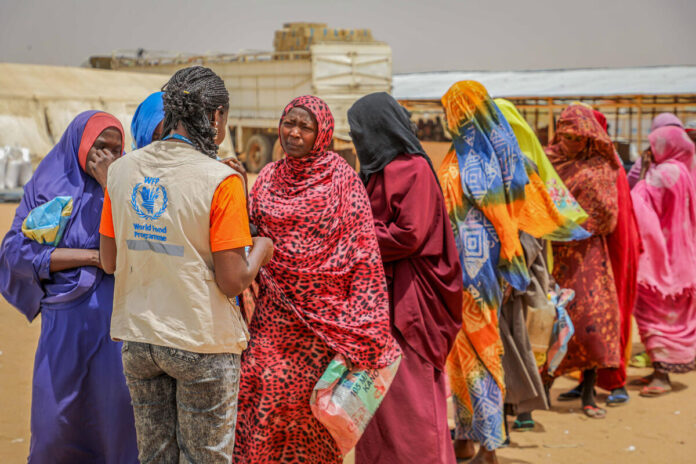
In the face of these severe challenges, the WFP managed to reach 3.1 million people with vital assistance in April 2026. The organization utilized two primary methods to deliver this aid, distributing 26,700 metric tons (mt) of food and transferring USD 1.3 million in cash directly to beneficiaries.
The specific breakdown of this emergency response operation includes providing direct Emergency Food Assistance (In-kind) to 1.8 million people as the largest share of the relief effort, supporting 1.1 million people through Emergency Food Assistance (Cash), delivering specialized Nutrition Programs to 203,000 vulnerable individuals, and supporting 13,000 people through Resilience capacity building. WFP placed a heavy focus on high-risk areas, delivering essential aid to 2.1 million people living in zones actively suffering from famine or facing a severe risk of famine.
The humanitarian response spans across five major regions of Sudan, though the volume of assistance varies based on local needs. In the Darfur States, 1.3 million people were assisted with the distribution of 8.1K metric tons of food and USD 1.8 million transferred in cash. In Northeast Sudan, 945,000 people received support, which included 1.4K metric tons of food and a substantial cash allocation of USD 9.6 million.
The Kordofan States saw 387,000 people supported with 15K metric tons of food and USD 623,000 in cash, while Southern Sudan reached 237,000 people with 1.4K metric tons of food and USD 385,000 in cash transfers. In the conflict-torn capital of Khartoum, 160,000 people were assisted through the delivery of 543 metric tons of food and USD 650,000 in cash.
Despite the broad scope of these current operations, WFP is sounding an urgent alarm regarding its financial sustainability. As of May 12, the total funding received for the year 2026 stands at just USD 87.2 million.
This is a drastic decline compared to the USD 654 million secured over the course of 2025, representing a mere 13% of the previous year’s total contributions. The primary donors who have provided a lifeline to the operation so far include the UN Country Based Pooled Funds with USD 51.5 million, Canada with USD 12.4 million, the UN Central Emergency Response Fund (UN CERF) with USD 7.2 million, Private Donors with USD 3.8 million, Norway with USD 3.2 million, Sweden with USD 2.9 million, Finland with USD 2.3 million, Germany with USD 2.2 million, Japan with USD 1.3 million, Iceland with USD 398,000, and Lithuania with USD 58,000.
WFP has explicitly stated that it faces a staggering net funding requirement of USD 578.7 million to sustain its relief operations from May to October 2026. The organization warns that if immediate international financial support is not secured, the aid supply pipeline could collapse, leaving millions of vulnerable people at imminent risk of starvation.