
The Korea International Cooperation Agency (KOICA) Ethiopia Office has held the 2026 World Friends Korea (WFK) Partnership Conference in Addis Ababa, bringing together Korean and Ethiopian officials, volunteer host institutions and volunteers to strengthen cooperation and improve the impact of the program in Ethiopia.
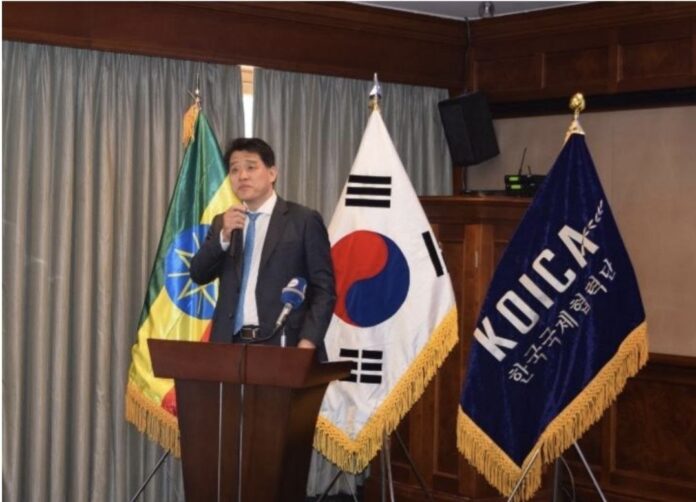
The conference took place on May 13 at Sheraton Addis and provided a platform for dialogue, shared learning and experience exchange among stakeholders involved in the WFK program.
KOICA Ethiopia Country Director Kim Taeyoung opened the meeting, while South Korea’s Ambassador to Ethiopia, Jung Kang, said bilateral ties between Ethiopia and Korea date back to Ethiopia’s participation in the Korean War through the Kagnew Battalion. He added that relations have expanded steadily since diplomatic ties were established in 1963 and the Korean Embassy opened in 1965.
According to the ambassador, cooperation between the two countries has evolved into a broad and future-oriented partnership covering several development sectors.
Representing the Ministry of Finance, Dereje Girma said Korean volunteers have made important contributions to community development and technical cooperation efforts across Ethiopia. He called for stronger institutional accountability and coordination to ensure the sustainability of ongoing initiatives.
Dereje described the volunteers as “a living bridge” between Ethiopia and South Korea through their work in healthcare, education, science, technology and social welfare. He also said KOICA’s presence in Ethiopia since 1995 has gone beyond project implementation by promoting knowledge exchange, institutional capacity building and people-to-people ties.
During the conference, volunteers You Heedae and Shin Hyeonjeong presented their activities and shared experiences from their host institutions. A presentation on the KOICA WFK Volunteer Program also highlighted its objectives, achievements and contribution to community development and institutional capacity building.
Discussions focused on the importance of direct institutional participation in identifying local needs and the role of volunteer programs in promoting cross-cultural understanding and professional exchange.
Participants also emphasized the need for continuous communication, mutual learning and active institutional engagement to sustain the effectiveness of the WFK volunteer program in Ethiopia.