
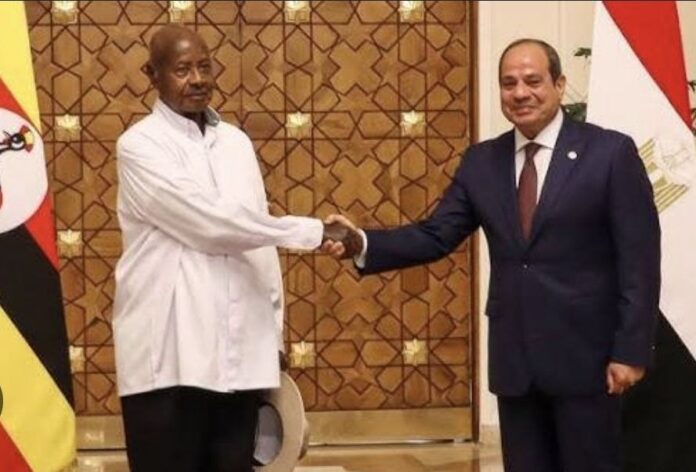
Ugandan President Yoweri Museveni and Egyptian President Abdel Fattah el-Sisi have agreed to further strengthen their bilateral relations to manage the Nile River in an “equitable and sustainable” manner. This meeting, held on May 13, 2026, at the Entebbe State House, is considered a significant milestone in Egypt’s efforts to expand its alliances with upper riparian states.
This high-level summit occurred at a time of increased regional concerns following the Grand Ethiopian Renaissance Dam (GERD) becoming fully operational in 2025. For Cairo, the urgency is paramount; Egypt is currently facing a “severe water scarcity crisis,” with the annual per capita water share falling below 500 cubic meters, which is only half of the water poverty threshold set by the United Nations.
A standout feature of the discussion was President Museveni’s new collaborative proposal regarding the Nile Basin. Noting that the encroachment on wetlands is a primary threat to the health of the Nile, Museveni explained that population growth and a lack of alternative economic opportunities are driving farmers into these fragile ecosystems.
To prevent this, the two leaders agreed on an ambitious aquaculture initiative. The vision aims to transition small-scale farmers away from vulnerable wetlands and into modern fish farming. As part of this commitment, Egypt will share its technical expertise and coordinate private investors to establish modern aquaculture projects in Uganda.
The ultimate goal is to create jobs, increase foreign exchange earnings, and naturally preserve the quality of Nile water by reducing agricultural runoff. “The biggest help I want from you is fish farming,” Museveni told el-Sisi. “Fish has high global demand; this project will not only lift our people out of poverty but also help protect the wetlands.”
The meeting in Kampala was driven by the ongoing tensions surrounding the Renaissance Dam. While Ethiopia asserts that the dam is vital for generating electricity and lifting millions of its citizens out of poverty, Egypt views any form of unilateral control over the Nile as an existential threat.
President el-Sisi emphasized that Egypt still seeks a “legally binding agreement” regarding the operation of the dam. By strengthening its ties with Uganda, a highly influential member of the East African Community, Cairo is reinforcing its position that Nile water management should be a collective and regulated effort rather than the result of unilateral decisions.
The presidential visit also served to bolster trade and security cooperation. The two leaders directed their respective cabinets to expedite the implementation of agreements reached during Museveni’s visit to Cairo in August 2025. Key economic pillars of the new alliance include renewable energy, where Egyptian companies will work with Ugandan partners on solar and hydro infrastructure; value addition, with both leaders calling for a focus on processing iron ore, hides, and fruits domestically rather than exporting raw materials; and the establishment of a Joint Business Council to facilitate investment between Cairo and Kampala. Additionally, the leaders discussed the conflicts currently shaking the continent. In their joint statement, they expressed deep concern over the instability in Sudan, Somalia, and the Eastern Congo, reaffirming their support for “Africa-led peace processes” and strict respect for national sovereignty.