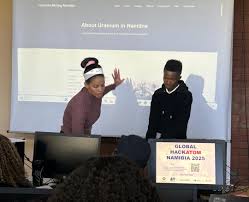
The national stage of the Global HackAtom student championship – a 24-hour international contest challenging participants to develop practical, innovation-driven solutions in nuclear technologies – was held in Namibia on April 4, 2026.
The event was organised by the Peoples’ Friendship University of Russia named after Patrice Lumumba (RUDN University) with the support of the Russian State Corporation Rosatom. The judging panel brought together leading experts from the National Research Nuclear University MEPhI, the Nizhny Novgorod State Technical University named after R. E. Alekseev, and the University of Namibia (UNAM).
This year’s challenge tasked students with designing a comprehensive solution for the sustainable energy supply of southern Africa’s coastal regions – using Floating Power Units (FPUs) as a case study based on Namibia’s specific conditions. Teams were required to evaluate the technical potential of nuclear energy, assess geological risks such as seismic activity and tsunamis, and present an economic rationale for their selected FPU design.
Twenty teams from across Namibia competed, with “NamHack Innovators” from the University of Namibia claiming first place. The team will now represent the country at the Global HackAtom 2026 Grand Final in Russia this September.
“For Namibia, the Global HackAtom championship is more than a competition – it’s an important platform for developing engineering thinking, research culture, and young people’s interest in cutting-edge energy technologies,” emphasised CEO of Rosatom Central and Southern Africa Ryan Collyer. “It’s inspiring to see universities, experts, and young professionals come together to tackle real-world challenges that contribute to sustainable development across the country and the region.”
Captain of the winning team “NamHack Innovators” Lemmy Nyambe described the experience as transformative: “Participating in the Global HackAtom has been both inspiring and invaluable. It allowed us to apply what we’ve learned in a real-world setting while strengthening our teamwork, creativity, and problem-solving skills under tight deadlines. We are honoured to represent Namibia at the finals in Russia and grateful to the organisers and partners – Rosatom, RUDN University, MEPhI, and the University of Namibia – for this opportunity.”
Ethiopia has already made its mark on the Global HackAtom map. In 2024, Ethiopian student teams participated in the championship, reflecting the country’s growing interest in nuclear science and innovative energy solutions. As Ethiopia advances its ambitions to introduce nuclear power into its energy mix – as outlined in Vision 2030 – competitions like HackAtom provide valuable hands‑on experience for young professionals.