Kenya and the United Kingdom are pushing to significantly expand their historic security and military framework into emerging technological domains, including cyber capabilities, maritime security, and defense tech modernization. The move toward higher-tech cooperation comes despite an ongoing impasse over the legal ratification of the bilateral Defence Cooperation Agreement (DCA) that governs British military operations on Kenyan soil.
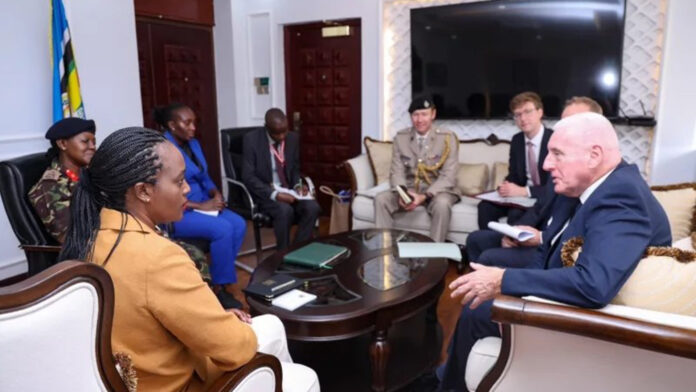
The renewed bilateral ambition was outlined following high-level discussions held at Defence Headquarters in Nairobi between Kenya’s Defence Cabinet Secretary, Soipan Tuya, and the UK Minister of State for Defence, Lord Vernon Coaker. The two defense chiefs met to discuss broadening joint operations and strengthening strategic alignment across counter-terrorism, intelligence sharing, and joint military exercises.
During the bilateral session, Defence CS Soipan Tuya emphasized that Kenya and the UK remain anchored by long-standing Commonwealth ties and a shared commitment to regional stability.
“Kenya and the UK share a strong and evolving bilateral relationship, anchored in our Commonwealth ties and elevated to a strategic Partnership, with cooperation spanning trade, security, climate action, sustainable development, and people-to-people ties,” Tuya stated. “Our defence partnership remains an important pillar of the Kenya-UK relationship… We reaffirm Kenya’s commitment to deepening this cooperation and advancing our shared interests.”
The high-level talks build upon the 2025–2030 Strategic Partnership signed between Nairobi and London, which prioritizes science, emerging technologies, counter-insurgency, and collective cyber defense. Under this umbrella, the UK announced over £70 million (approx. Sh16 billion) in defense support and equipment sales during President William Ruto’s visit to London.
Currently, the UK military trains more than 1,100 Kenya Defence Forces (KDF) personnel annually. British troops rely heavily on the British Army Training Unit Kenya (BATUK) in Laikipia for complex environmental exercises. According to the Ministry of Defence, the UK plans to transition toward larger, consolidated multi-battlegroup exercises, scheduling five major drills each across the 2025–2026 and 2026–2027 financial cycles.
Despite optimistic diplomatic statements, underlying strain remains around the operational and legal status of BATUK. The formal renewal of the Defence Cooperation Agreement signed in 2021 remains stalled in the Kenyan National Assembly. Currently, British military presence operates under mutual extensions of the legacy 2016 framework.
Kenyan lawmakers, civil society organizations, and human rights activists have raised serious reservations regarding primary legal jurisdiction. Members of Parliament maintain that British personnel accused of committing serious crimes on Kenyan territory—including murder, assault, and environmental degradation—must be tried within Kenya’s domestic justice system rather than under UK military jurisdiction.
Public outrage continues to focus on unresolved cases, most notably the 2012 murder of Agnes Wanjiru, a Kenyan woman whose body was found near a BATUK training encampment in Nanyuki. The National Assembly Defence Committee recommended strict amendments to the proposed DCA to strip military immunity, enforce environmental accountability, and guarantee justice for local victims before any formal parliamentary ratification occurs.
This legal friction has already produced operational disruptions. In mid-2026, the British Army temporarily cancelled a major training exercise following licensing holds linked to the DCA impasse, requiring emergency diplomatic intervention from Kenya’s Ministry of Foreign Affairs to clear the disruption.