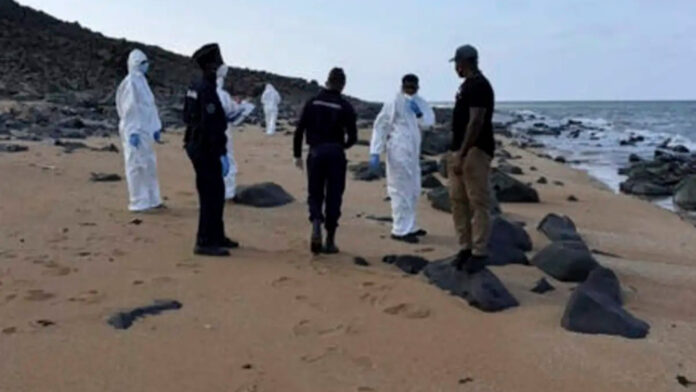
At least 139 migrants—including at least 15 children—have died after an severely overcrowded vessel capsized off the coast of Djibouti. Search and rescue operations remain underway as local authorities and international humanitarian agencies search for at least 84 individuals who remain missing in the waters near Guhere, north of the port town of Obock.
The vessel set sail during the night of October 8 with 305 passengers aboard, the vast majority of whom were Ethiopian nationals. According to survivor accounts and officials from the United Nations’ International Organization for Migration (IOM), the vessel began taking on water and sank rapidly shortly after departure due to extreme overcrowding.
Djiboutian authorities and local residents managed to rescue roughly 82 survivors from the surf, while bodies continued to wash ashore in the hours following the sinking. The death toll rose sharply on Sunday as emergency responders recovered additional victims from the coastline.
Speaking from Djibouti, Alexandre Coissac, IOM Chief of Mission, described the harrowing scene confronting first responders and community members on the ground.
“What is terrible is that they were buried with no names, in a common grave, like in a war situation,” Coissac said. “They all have a mother, a father, and we may never learn what happened.”
Coissac noted that local authorities were quickly overwhelmed by the sudden influx of casualties. Beyond the official tally maintained by Djiboutian municipal workers, several bodies were buried directly by surviving migrants and local residents before formal documentation could take place. Authorities continue working to verify these additional graves to establish a definitive count.
Survivors are receiving emergency medical assistance, shelter, and psychological trauma support at the IOM Migrant Response Centre in Obock. Many were treated for severe seawater ingestion and exhaustion. Officials reported that while some survivors have used satellite phones provided by aid workers to inform families back home of their safety, others have already learned that relatives traveling alongside them perished in the wreck.
The maritime passage between Djibouti and war-torn Yemen—known as the “Eastern Route”—is recognized as one of the busiest and most dangerous migration corridors in the world. Every year, tens of thousands of young men, women, and children from the Horn of Africa transit through Djibouti, risking human trafficking, extreme heat, and dangerous sea crossings across the Bab el-Mandeb Strait. Most hope to reach Gulf Cooperation Council (GCC) states, primarily Saudi Arabia, in search of employment and economic security.
Paradoxically, this migration wave continues unabated despite escalating military conflicts and deteriorating security conditions within Yemen. IOM monitoring data indicates that while thousands of Ethiopian migrants continue moving east toward Yemen, thousands of Yemeni refugees simultaneously cross the strait in the opposite direction toward Djibouti to flee domestic fighting.
Following the catastrophe, IOM Director-General Amy Pope issued an urgent appeal to global donors and governments to establish regulated migration channels.
“No one gets into a boat like that unless they believe there is no other safe way,” Pope stated. “We cannot keep treating these deaths as normal. Safe and legal pathways save lives. I am asking governments and donors to act before the next boat goes down.”
More than 900 migrants lost their lives or disappeared along the Eastern Route in the previous year alone, according to records maintained by the IOM Missing Migrants Project. Rescue teams and Djiboutian coastal patrols are continuing search sweeps along the Obock coastline as hopes fade for those still missing at sea.