As the African Continental Free Trade Area (AfCFTA) enters its critical implementation phase, the Pan-African Payment and Settlement System (PAPSS) is rapidly scaling up its infrastructure to eliminate the continent’s historical reliance on external financial intermediaries.
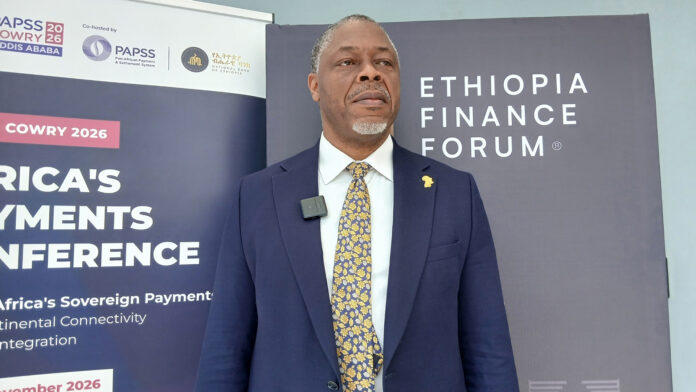
In an exclusive interview with HER , Mike Ogbalu III, CEO of PAPSS, outlined how the system is fundamentally rewiring the economics of intra-African trade. “A payment that originates here in Addis Ababa will arrive in Lagos, Nigeria, in 120 seconds,” Ogbalu stated. “It will originate in Ethiopian Birr, and it will arrive in Lagos in Nigerian Naira.”
This efficiency is not merely technical—it is strategic. According to recent data from Afreximbank, PAPSS transactions have demonstrated cost savings of between 92 and 95 percent per transaction, a 99.99 percent reduction in processing time, and up to an 80 percent reduction in foreign exchange requirements. These figures represent a seismic shift for African businesses that have historically lost valuable time and capital to correspondent banking networks routed through New York or London.
Ogbalu was blunt about the structural inequities PAPSS is designed to dismantle. “Before the advent of PAPSS, a payment going from Lagos to Ghana first travels halfway around the world to a place like New York or London before coming back to Ghana,” he explained. “When a payment touches any other country outside of the continent, it means that that country can control whether you pay, whether you trade, and with whom you are able to trade.”
This dependency has been a persistent vulnerability. United Nations Secretary-General António Guterres recently called for reforms of a global financial architecture that he said perpetuates “century-old injustices,” noting that African countries often pay up to three times benchmark rates for borrowing. PAPSS represents a concrete African-led response to that systemic asymmetry.
The system has expanded dramatically in 2026 alone. In July, the Bank of Central African States (BEAC) officially joined PAPSS, opening a strategic gateway into the CEMAC region—a market of more than 72 million people spanning Cameroon, the Central African Republic, the Republic of Congo, Gabon, Equatorial Guinea, and Chad. This followed the earlier accession of the Bank of Algeria in August 2025.
As of September 2026, PAPSS operates in more than 30 African countries across all five regions, connecting 24 national and regional central banks, over 200 commercial banks and payment service providers, and 16 switches. Approximately 10 additional countries have joined the ecosystem this year alone.
The urgency behind PAPSS’s expansion is rooted in a stark reality: Africa trades with itself at levels far below its potential. Intra-African trade accounted for approximately $213.8 billion in 2025—a mere fraction of the continent’s $1.4 trillion in total trade. Ogbalu argues that payment inefficiency is a primary culprit.
“There is no trade without payments,” he told HER . “Payment is the trigger for every trade. So once you are not able to pay, you are not able to trade.”
AfCFTA Secretary-General Wamkele Mene has projected that intra-African trade will reach $250 billion in 2026, up from $220 billion in 2025. Meeting that target—and exceeding it—will require the payment infrastructure to keep pace. Afreximbank’s African Trade and Economic Outlook 2026 estimates that PAPSS alone could reduce foreign exchange costs by 20 to 30 percent, a critical lever for small and medium-sized enterprises that dominate African commerce.
The usage data suggests the system is gaining traction. Between comparable periods in 2025 and 2026, transaction volumes across the PAPSS network increased by approximately 1,000 percent, while transaction values grew by approximately 120 percent. Nigeria, one of the system’s founding champions, recorded an 1,100 percent increase in transaction volumes.
For Ogbalu, the ultimate objective transcends efficiency metrics. “We have taken our destiny in our hands,” he said. “We have built this payment system and we now control it as Africans.”
Yet challenges persist. Adoption remains uneven, with regulatory support, technological infrastructure, and awareness varying significantly across markets. “A payment system can be excellent, but if businesses and consumers do not know that it exists, they will not use it,” Ogbalu acknowledged in a separate briefing. The next phase of the PAPSS strategy, beginning in 2027, will focus explicitly on market activation, customer awareness, and the development of priority payment corridors.
The system’s annual payments conference, PAPSS COWRY 2026, will convene in Addis Ababa on November 26–27, co-hosted with the National Bank of Ethiopia, to chart the next phase of continental payment integration.