A fresh wave of violent clashes in Baidoa, the largest city in Somalia’s South West State, has resulted in the tragic deaths and injuries of children, compounding an already catastrophic humanitarian emergency. According to the UN Children’s Fund (UNICEF) and various humanitarian organizations, the renewed hostilities have also caused structural damage to a local health facility, further restricting civilian access to critical medical care in a war-torn zone.
The recent outbreak of violence stems from deep-seated political instability. Clashes erupted between government forces and fighters loyal to the region’s former president, who was removed from office in March. Hostilities intensified after thousands of local armed fighters entered Baidoa, prompting the national army to secure control of the city following earlier strategic advancements.
“Children are once again bearing the heaviest burden of violence,” UNICEF stated, expressing profound alarm over the deteriorating security situation. The agency has issued an urgent plea to all warring factions, demanding the absolute protection of children, schools, and medical facilities, alongside safe and unhindered access for humanitarian workers.
This sudden escalation of conflict hits a population already buckling under decades of multi-layered crises. Somalia has long battled persistent food insecurity fueled by recurring cycles of violence, massive internal displacement, disruptions in global supply chains, and extreme climate shocks, including severe droughts and flash floods.
Currently, UN agencies report that roughly two million children across Somalia are acutely or severely malnourished, positioning the nation at the center of one of the world’s most alarming malnutrition emergencies. In Baidoa alone, approximately 26,000 residents face catastrophic food insecurity—the absolute highest classification on the hunger scale—placing them on the brink of localized famine. To make matters worse, meteorologists warn that a strengthening El Niño weather pattern is poised to deepen the crisis by exacerbating the upcoming rainy season.
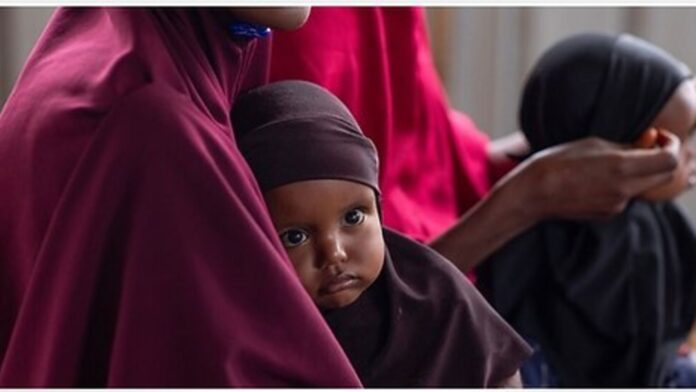
The human toll of these overlapping crises is visible in displaced families across the country. Local accounts, such as that of a mother named Hawo, highlight the relentless tragedy facing civilians. After a mortar shell struck her home in Baidoa—killing her father—and subsequent fighting claimed the life of her brother, Hawo was forced to flee with her young daughter to Mogadishu.
Living with relatives and struggling to secure basic needs, Hawo notes that her family often eats only once a day. Her daughter, Farhiya, has grown listless and severely underweight due to malnutrition. Although a neighbor recommended local medical intervention, clinics are routinely forced to turn away desperate women and children due to a crippling lack of resources.
As human suffering surges, aid organizations find themselves severely underequipped to respond. The UN World Food Programme (WFP), which forms the backbone of food security relief in Somalia, is facing unprecedented operational constraints driven by widespread humanitarian funding cuts.
While the WFP was able to reach more than four million vulnerable people monthly during previous peak crises, severe resource shortfalls have crippled its capacity, reducing its reach to just over 670,000 individuals today. Aid directors note that while timely international funding successfully averted a full-scale famine during the historic 40-year drought, current financial gaps are forcing agencies to make agonizing decisions about who receives life-saving aid and who is left behind.


