By HER staff reporter
Business leaders in Kenya have strongly advocated for a fundamental shift in the country’s economic and commercial relationship with China, urging a transition away from the heavy importation of finished consumer goods toward localized manufacturing, assembly operations, and direct technology transfer. Speaking at the opening of the ninth Kenya International Industrial Expo and Kenya Investment & Trade Fair 2026 at the Sarit Expo Centre in Nairobi, stakeholders emphasized that sustainable economic development requires moving past simple transactional trade.
Gao Wei, Managing Director of Afripeak Expo, highlighted that long-term industrial cooperation relies heavily on establishing physical production roots within the region. Pointing out the limitations of a purely import-driven model, he noted that true partnership involves transferring expertise, training local technicians, assembling or producing goods locally, and generating long-lasting employment opportunities.
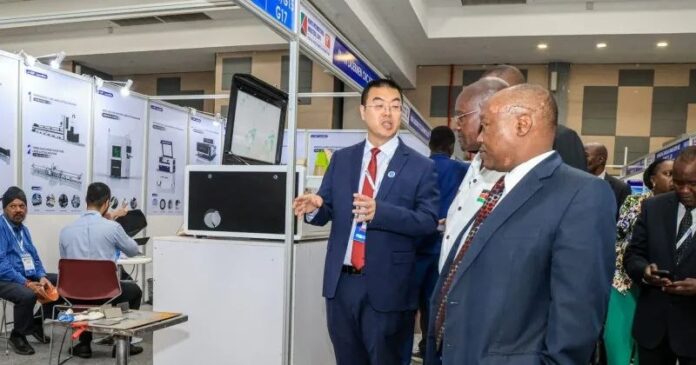
The three-day exhibition, which runs through September 5, has convened a diverse array of local and international manufacturers, investors, and suppliers, including a specialized business delegation from China’s prominent manufacturing hub, Guangdong Province. The event showcases advanced industrial machinery, including laser cutting and engraving tools, with practical applications spanning metal fabrication, furniture production, construction, packaging, and advertising.
Echoing these sentiments, Joseph Mutavi Kithu, National Director of the Kenya National Chamber of Commerce and Industry (KNCCI), stressed that Kenya’s overarching economic transformation hinges on boosting productive sectors and embedding technology and innovation deep within the economy. He underlined that industrialization is not restricted to mega-factories, but crucially incorporates the thousands of micro, small, and medium-sized enterprises (MSMEs), suppliers, technology providers, and service businesses forming the backbone of domestic commerce.
While Kenya has historically maintained a massive trade relationship with China—relying heavily on imported machinery, equipment, and finished consumer products— policymakers and private sector players increasingly face the challenge of helping local enterprises climb higher up the value chain. Organizers maintain that the ultimate benchmark for the success of trade fairs and international partnerships will not be the volume of imported goods sold, but rather the extent to which these engagements spark tangible capital investments, facilitate meaningful technology transfers, and establish sustainable domestic production hubs capable of servicing the broader East African market.