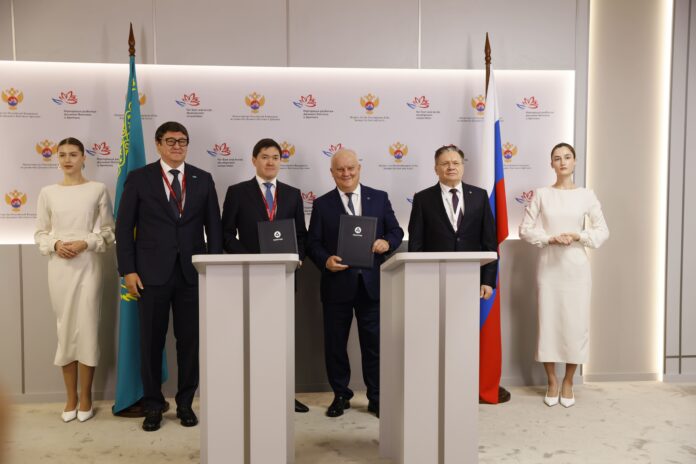
On September 3, on the sidelines of the Eastern Economic Forum, Rosatom State Corporation and Kazakhstan Nuclear Power Plants LLP (KNPP) signed an EPC contract for the construction of the Balkhash Nuclear Power Plant. The plant will comprise two power units with a total electrical capacity of 2,400 MW. The nuclear power plant will be built near the village of Ulken in the Zhambyl District of Almaty Region, Kazakhstan.
Rosatom First Deputy Director General for Nuclear Energy and President of JSC Atomstroyexport Andrey Petrov signed the contract on behalf of the Russian side, while Director General of KNPP Ernat Berdigulov signed on behalf of the Kazakhstani side. The signing ceremony was attended by Rosatom Director General Alexey Likhachev and Chairman of the Agency of the Republic of Kazakhstan for Atomic Energy Almasadam Satkaliev.
The signed contract defines the responsibilities of the Russian and Kazakhstani parties in the future Balkhash Nuclear Power Plant project. As the leader of the international consortium, Rosatom will be responsible for the entire project implementation cycle, from design and procurement through construction and commissioning to the handover of the completed facility to the customer.
The future plant will feature state-of-the-art VVER-1200 reactors (water-cooled power reactors with an electrical output of 1,200 MW) of Generation III+. This technology meets the strictest international safety requirements and is already being successfully used at operating and under-construction facilities in Russia, Egypt, Belarus, Turkey, Bangladesh, Hungary, and China. The reactor has a service life of 60 years, with the possibility of extending it by a further 20 years.
“The signed document marks a new stage in our cooperation with Kazakhstan. In the near future, Rosatom will carry out design work and establish an international consortium of equipment suppliers. At every stage of the project, our primary objective will be to build and commission power units that meet the strictest international safety and efficiency requirements. We are convinced that Russian nuclear technologies will provide a reliable foundation for Kazakhstan’s energy independence and sustainable development,” noted Rosatom Director General Alexey Likhachev.
Site investigation work, which began in August 2025, is currently underway in the area where the future nuclear power plant will be located. Specialists have drilled more than 60 boreholes to depths of up to 120 metres and collected samples for analysis. The materials are being examined in laboratory conditions to determine the optimal site for the power units. The site investigation work will be completed in 2027, after which engineers will begin preparing the documentation required to obtain the permits needed to commence construction of the power units.
The Kazakhstan project reflects Rosatom’s integrated approach to nuclear energy development, connecting expertise across the nuclear fuel cycle –from uranium mining and processing to the design, construction and operation of nuclear power plants.
Across Africa, countries are considering nuclear energy as part of their long-term plans to meet rising electricity demand, support industrial development and strengthen energy security. Their starting points differ: some countries are developing the regulatory frameworks, institutions and skills needed for future nuclear programmes, while uranium-producing states are also considering how resource development can support broader national energy and industrial objectives.
Egypt’s four-unit El-Dabaa Nuclear Power Plant demonstrates that, for some African countries, nuclear energy is already moving from long-term planning to implementation. With a total capacity of 4,800 MW, El-Dabaa is expected to generate around 37 billion kWh of electricity annually and supply approximately 10% of Egypt’s electricity needs.
For uranium-producing African countries at the beginning of their nuclear-energy journeys, Kazakhstan’s first NPP project offers a relevant long-term example. Its transition from a major uranium producer to a country developing domestic nuclear generation highlights how resource development can be linked with skills training, national infrastructure and reliable low-carbon power capacity.