Kenya has officially proposed that the year 2030 be declared the Year of Peace, Security and Stability in Africa, a bold initiative aimed at breathing new life into the continent’s long-standing “Silencing the Guns” agenda. The proposal was introduced during the 21st Extraordinary Session of the Assembly of the African Union on Strengthening Mechanisms for Conflict Prevention and Resolution in Africa, gathering regional leaders to recalibrate how the continent handles internal security and conflict management.
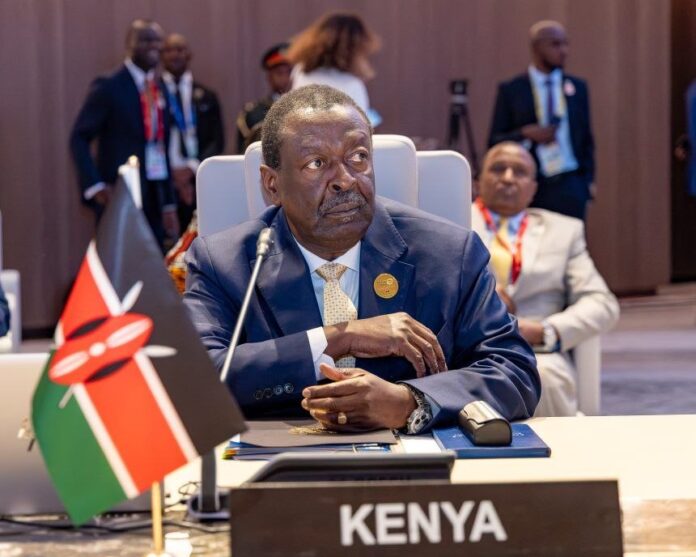
Representing President William Ruto at the high-level summit, Prime Cabinet Secretary Musalia Mudavadi delivered Kenya’s official address, reaffirming the nation’s steadfast dedication to championing dialogue, mediation, and peacebuilding. Mudavadi underscored that enduring solutions to African challenges must originate from within the continent, urging member states to actively bridge the gap between lofty political commitments and concrete, lasting outcomes for a prosperous Africa.
The extraordinary session provided a crucial strategic platform for African heads of state to deliberate on critical shortcomings in current continental architectures. Discussions heavily centered on ways to bolster mechanisms for conflict prevention, mediation, peace support operations, and post-conflict peacebuilding. The summit was guided by prominent continental leaders, including Angolan President João Manuel Gonçalves Lourenço, who serves as the African Union Champion for Peace and Reconciliation in Africa, and Burundian President Évariste Ndayishimiye, the Chairperson of the African Union.
Addressing fellow delegates, PCS Mudavadi stressed that Africa must aggressively upgrade its institutional capabilities to anticipate emerging geopolitical and domestic security threats proactively rather than reacting after crises erupt. He emphasized that the continent’s political ambitions must be matched by adequate institutional capacity and reliable resources to deliver sustainable peace on the ground.
A central pillar of Kenya’s advocacy at the summit was the strengthening of the African Peace and Security Architecture (APSA) and the African Governance Architecture (AGA). Mudavadi called for vastly improved coordination and synergy among the African Union, individual member states, and various Regional Economic Communities (RECs). This collaborative alignment forms a core component of AU Assembly Decision 967 on Institutional Reform, a framework actively championed by President William Ruto.
Beyond operational coordination, the summit confronted the persistent challenge of funding security initiatives. Mudavadi placed heavy emphasis on securing sustainable, predictable financing for Africa’s peace and security agenda to eliminate reliance on external donors. He advocated for the progressive capitalization of the AU Peace Fund toward its ambitious USD 1 billion target, the diversification of African financing sources, and the rigorous implementation by all member states of the 0.2 percent import levy as a viable, home-grown pathway to true financial autonomy for the Union.
Culminating days of intense diplomatic consultations, the Summit formally adopted a comprehensive Decision and Plan of Action on Strengthening Mechanisms for Conflict Prevention and Resolution in Africa. This milestone framework sets out granular, actionable measures designed to dramatically enhance the operational effectiveness of continental mediation tools.
Ultimately, the outcomes of the 21st Extraordinary Session have reinforced the collective resolve of African nations to accelerate progress toward silencing all guns, fostering stability, and safeguarding development across every region of the continent.