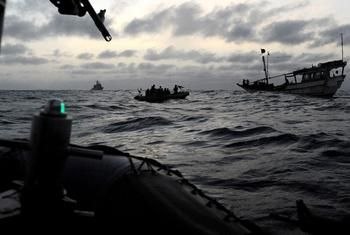
As mounting security challenges threaten key international trade lanes, the Djibouti Maritime Authority has issued a strong call for closer, cross-border information-sharing among East African nations. Speaking at the recent 5th Regional Maritime Law Enforcement Dialogue for the Red Sea and Gulf of Aden in Nairobi, Abdurrahim Muhammad Ali of the Djibouti Maritime Authority emphasized that regional governments can no longer afford to operate in silos.
With maritime threats evolving rapidly and crossing national boundaries with ease, he argued that robust intelligence-sharing and operational coordination are the most effective defenses available.
The two-day conference, hosted in Kenya’s capital, brought together security officials from Djibouti, Ethiopia, Yemen, and Somalia to confront a shared array of vulnerabilities. Facilitated by the United Nations Office on Drugs and Crime (UNODC)—with backing from the European Union, INTERPOL, the International Maritime Organization (IMO), and the Intergovernmental Authority on Development (IGAD)—the dialogue served as a vital forum for aligning regional security strategies.
For Djibouti and its neighbors, the timing of the summit could not be more critical. Regional officials pointed out that shifting geopolitical dynamics and ongoing maritime tensions in the Middle East have a direct, cascading effect on the Horn of Africa.
Mr. Ali specifically highlighted how broader international conflicts and attacks on freedom of navigation in nearby vital waterways—such as the Strait of Hormuz—divert global naval attention away from the Gulf of Aden. Criminal syndicates and opportunistic pirates are quick to exploit these global distractions, capitalizing on stretched maritime forces to ramp up attacks in areas where they believe security is looking elsewhere.
Beyond piracy, Mr. Ali detailed a sprawling list of transnational security concerns facing Djibouti and its neighbors, including maritime terrorism, illegal fishing, armed robbery at sea, human trafficking, irregular migration, and narcotics smuggling. Because these illicit networks operate seamlessly across borders, individual nations attempting to fight them in isolation are routinely outpaced.
”The practical outcome is to get closer and share information from Yemen, Somalia, and Ethiopia. We have the same challenges,” Mr. Ali noted during the discussions.
Throughout the Nairobi dialogue, participants focused heavily on practical solutions to improve maritime domain awareness and build synchronized responses to incidents at sea. Leaders agreed that establishing harmonized systems for transmitting real-time intelligence between coast guards and maritime agencies is essential. By bridging communication gaps between nations like Djibouti, Yemen, Somalia, and land-linked partners such as Ethiopia, authorities can better anticipate criminal movements and protect vital shipping lanes.
Ultimately, the consensus emerging from the dialogue was clear: in a maritime corridor as vital and bustling as the Red Sea and Gulf of Aden, national borders are entirely porous to modern criminal enterprises. Only through synchronized, cross-border cooperation can regional authorities safeguard seafarers, protect international commerce, and maintain long-term stability along some of the world’s most indispensable trade arteries.