Starlink’s expansion in Africa is moving beyond satellite dishes and fixed broadband as mobile operators begin connecting smartphones directly to its satellites.
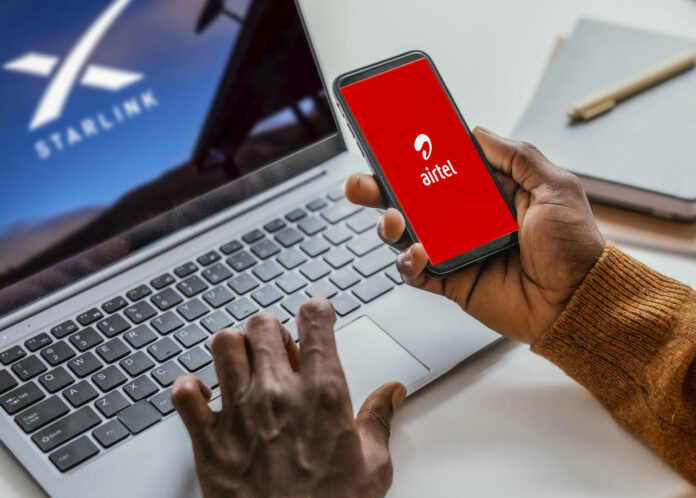
Airtel Africa’s launch of Starlink Mobile in the Democratic Republic of Congo has put the technology into commercial use without requiring customers to buy satellite equipment.
The DRC became the first African market where Airtel and Starlink commercially deployed the service on August 14, allowing customers with compatible LTE Android phones to send SMS and use light-data applications such as WhatsApp in areas without terrestrial mobile coverage.
“By combining Airtel’s terrestrial network with Starlink’s satellite technology, we are extending essential connectivity beyond the limits of mobile infrastructure,” Airtel Africa CEO Sunil Taldar said.
Customers do not need a Starlink dish or separate satellite device. They need a compatible phone, an active Airtel DRC data bundle or data roaming, and a clear view of the sky. Airtel is offering eligible customers a 30-day trial before access moves to eligible data bundles.
That removes a cost that has limited Starlink’s reach in Africa since the company began launching its broadband service on the continent.
Starlink’s conventional service requires customers to buy a kit containing the satellite dish, router, cables and mounting equipment. An Ookla analysis cited in June put the cost of Starlink hardware across African markets at between US$200 and US$700. The same analysis estimated that Starlink had about 500,000 African users at the end of 2025, compared with about 10 million globally.
In Kenya, the standard Starlink kit was listed at KSh49,900 (about US$386) in December 2025, while the Mini kit was available from about KSh27,000 (US$209). In Nigeria, the standard kit cost about ₦590,000 (US$407), according to TechCabal’s December pricing analysis.
Monthly prices have also varied across markets. In Kenya, Starlink’s residential plans included a KSh1,300 (about US$10) 50GB option and a KSh6,500 (about US$50) unlimited plan. In Nigeria, the residential plan was priced at ₦57,000 (about US$39) a month.
The figures have made the hardware purchase a larger barrier than the satellite connection itself for many potential customers.
The Ookla analysis found that Starlink’s monthly price was competitive with local internet providers in some markets, including Ghana and Zimbabwe, while fibre remained cheaper in countries such as Kenya, Nigeria and Rwanda. Hardware costs, however, remained between US$200 and US$700 across markets.
Starlink’s direct-to-phone model changes that calculation for customers because the satellite terminal sits outside the user’s home. The satellite connection is instead being offered through an existing mobile operator.
The DRC launch is the first commercial example of that model in Africa. Airtel says the service is intended for customers and organisations operating outside conventional network coverage, including transport and logistics companies, humanitarian organisations, health workers, farmers and mining operations.
Airtel DRC managing director Theirry Diasonama said the country’s size and geography meant that some people live, work and travel beyond the reach of conventional mobile infrastructure.
“This service provides an additional layer of connectivity, helping customers remain reachable, informed and connected even in areas where terrestrial coverage is unavailable,” he said.
The DRC is not the only market where Starlink is being incorporated into existing connectivity businesses.
In Uganda, Paratus became the first internet service provider to launch Starlink’s low-Earth-orbit service on August 24 after the Uganda Communications Commission and Starlink signed an operational licence agreement in May. The company is targeting enterprise customers in remote areas, including mining, healthcare, tourism, NGOs and government.
“There has been significant demand for LEO services from enterprise customers who have been waiting for Starlink to become available in Uganda,” Paratus Uganda country manager Edwin Kyambadde said.
Paratus is offering Starlink as part of its wider network rather than as a standalone consumer product. The company says satellite connectivity will complement its existing terrestrial infrastructure and provide links for customers operating in areas where conventional networks are limited.
The two launches point to different ways of using the same satellite network.
In Uganda, an internet service provider is selling satellite broadband to businesses. In the DRC, a mobile operator is using Starlink to extend connectivity to phones that move beyond the reach of its terrestrial network.
Kenya has already tested the second model.
Airtel Africa and Starlink tested satellite-to-mobile data and messaging services in Kenya in March 2026. The tests connected compatible 4G smartphones to Starlink satellites in areas without terrestrial coverage. Commercial deployment still requires approval from the Communications Authority of Kenya.
Kenya is also among the African markets where Starlink already competes directly with fixed broadband providers. Starlink had about 24,999 Kenyan subscribers at the end of March 2026, representing 0.9% of the country’s fixed internet market, according to figures cited by industry reports.
The broader Starlink footprint has also expanded quickly.
Space in Africa reported 26 active African markets as of June 2026, with about 300,000 customers across those markets. Nigeria, Zimbabwe and Zambia accounted for about 64% of the continent’s subscriber base. Licensing fees varied from US$32,000 to US$575,000, an 18.5-fold difference between markets.
Those figures put another cost into the expansion equation: the price of obtaining permission to operate.
Starlink’s entry has varied sharply between African countries. Some governments have approved the service and allowed commercial operations, while others have imposed ownership, licensing or spectrum requirements that have delayed entry.
South Africa remains one of the largest markets without a commercial Starlink service.
SpaceX has been engaging with the Independent Communications Authority of South Africa over the rules governing satellite operators. At recent ICASA hearings, the company sought clarification on ownership, licensing and spectrum requirements.
The main dispute has centred on South Africa’s requirement that certain telecommunications licence holders have at least 30% ownership by historically disadvantaged South Africans.
The South African government introduced an equity-equivalent investment route in December 2025 that allows qualifying foreign-owned communications companies to meet empowerment objectives through investments in areas such as digital infrastructure and skills development instead of transferring a conventional equity stake.
But the regulatory question remains unresolved for Starlink. ICASA has said it has not received a formal licence application from the company, while the regulator has also maintained that legislative changes may be required before equity-equivalent investment programmes can replace the existing ownership requirement.
The differences between these markets are reflected in the pace of Starlink’s African expansion.
The company began its African rollout in Nigeria and Rwanda in 2023. The number of markets expanded to 26 by June 2026 and 27 according to subsequent industry reporting. At the same time, subscriber numbers have remained concentrated in a small group of countries.
The affordability issue has also extended beyond Starlink’s consumer business.
In Zimbabwe, the government has acquired Starlink kits for schools, while Starlink has donated hundreds of kits to schools and health centres in the Central African Republic, according to the Ookla analysis.
These deployments put the hardware cost on governments, institutions or other organisations rather than individual households.
The direct-to-phone model removes that requirement for a different group of users.
In 2012, Africa’s digital economy accounted for about 1.1% of GDP, or US$30 billion. By 2020, that had risen to 4.5%, or US$115 billion, with Google and the International Finance Corporation (IFC) projecting US$180 billion, or 5.2% of GDP, by 2025 and US$712 billion, or 8.5%, by 2050.