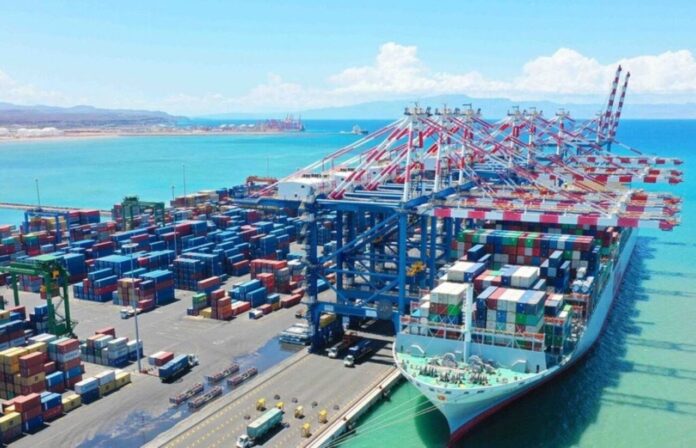
The Port of Djibouti retained an overwhelming monopoly on Ethiopia’s external trade during the 2025/26 financial year, processing 96.71 percent of all maritime cargo passing through regional gateways.
Data released by the Ministry of Transport and Logistics indicates that the logistics sector moved a total of 17.57 million metric tonnes of import and export freight, underscoring a heavy reliance on the Djibouti corridor despite ongoing government drives to diversify trade routes through Berbera, Tadjourah, and the Mombasa-Moyale corridor.
Imports constituted the vast majority of the volume, reaching 15.93 million tonnes, while exports trailed significantly at 1.64 million tonnes. The import mix was dominated by 9.35 million tonnes of general cargo—which expanded by roughly three million tonnes compared to the preceding financial period—alongside 4.23 million tonnes of fuel and 2.35 million tonnes of dry bulk. Conversely, dry bulk imports registered a contraction of approximately 1.26 million tonnes.
On the export side, agricultural commodities anchored outbound trade volumes. Coffee emerged as the leading export by volume, accounting for 440,090 tonnes or 26.79 percent of total exports. Pulses followed with 311,881 tonnes, oilseeds reached 234,550 tonnes, and fruits and vegetables registered 191,598 tonnes.
The ministry also noted progress in domestic containerization, reporting that 47,753 out of 63,857 twenty-foot equivalent units were packed locally. This domestic stuffing rate of 74.78 percent generated foreign exchange savings estimated at 12.08 million dollars.
Regarding modal split, road transport remained the primary conduit for domestic freight distribution, carrying 14.08 million tonnes or 80.15 percent of total volume.
The Ethio-Djibouti railway handled 3.32 million tonnes, translating to 18.92 percent of the freight, while air transport accounted for 164,781 tonnes or 0.94 percent, primarily serving perishable and high-value items. Among maritime alternatives, the Port of Berbera accounted for 2.74 percent of trade cargo, Tadjourah handled 1.23 percent, and the Mombasa-Moyale corridor processed 0.56 percent.
State Minister Denge Boru highlighted that the sector operated under considerable external pressures during the fiscal cycle.
Disruptions across the Red Sea and the Bab el-Mandeb strait compounded regional security concerns, drove up freight tariffs, and induced volatility in global shipping networks. In response, the administration is pushing forward with multimodal transport integrations and logistics reforms to streamline supply chains and lower trade transaction costs.