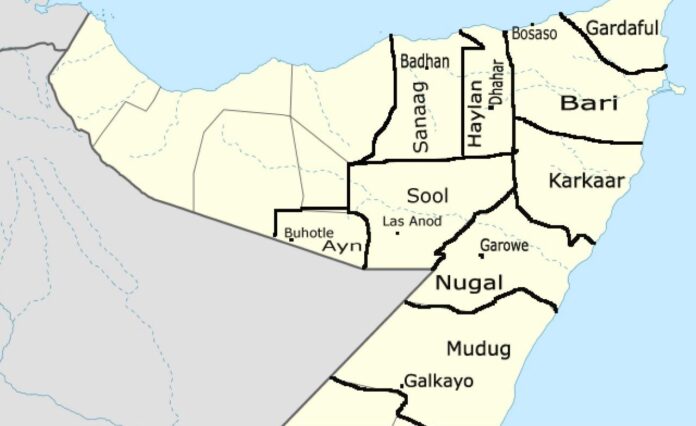
Authorities in Somalia’s semi-autonomous Puntland region have demanded an immediate explanation from international actors following a series of deadly coastal strikes in the Nugaal region. The military actions, which local sources and relatives attribute to foreign operations, have intensified a tense standoff over maritime security and sovereignty along the Horn of Africa coastline.
The controversy follows a string of violent incidents sparked by the August 17 hijacking of the Cameroon-flagged cargo vessel M/V Lutuf near Marraya in Puntland’s Eyl district. The ship was reportedly carrying critical military hardware, including Turkish weapons, communications gear, and satellite equipment destined for a Turkish military training facility in Mogadishu. Following its seizure, the vessel was steered toward the Nugaal coast.
In the wake of the hijacking, aerial bombardments and naval shelling struck coastal areas near Garmaal and Jiifle. Local reports and regional officials indicated that multiple individuals, including local fishermen, were killed or wounded when small boats near the hijacked vessel were targeted.
The strikes have drawn severe condemnation from families and community leaders. Following the burial of several victims in Garmaal, grieving relatives openly blamed Turkey for the drone and missile strikes. However, Turkish authorities have denied carrying out unauthorized operations or possessing information regarding specific airstrikes, leaving the exact chain of command and origin of the attacks shrouded in ambiguity.
Puntland’s Ministry of Security issued a stern statement condemning the attacks, emphasizing that military operations targeting coastal communities undermine vital anti-piracy cooperation. The administration stressed that while it remains fully committed to rooting out maritime crime, foreign forces cannot bypass regional protocols or risk civilian lives with impunity.
The maritime crisis has also exposed underlying friction between Puntland and Somalia’s federal government in Mogadishu. Puntland officials have launched independent investigations into the incidents, noting troubling information that external entities or networks from outside the region may be exploiting or even fueling the renewed piracy wave for ulterior political or economic objectives.
Meanwhile, Somalia’s federal Ministry of Defense acknowledged that it is aware of the military operations and shelling off the Puntland coast. State Minister of Defense Omar Ali Abdi asserted that the federal government is the primary legal authority responsible for authorizing counter-piracy operations in national waters. The Ministry promised a comprehensive report to clarify the roles of various international partners and regional bodies, though details remain sparse.
The flare-up comes at a highly sensitive juncture for Somalia as it grapples with a sudden resurgence of Indian Ocean piracy after years of relative quiet. Regional experts warn that uncoordinated foreign military responses, combined with a lack of transparency from international partners, risk alienating local populations whose cooperation is essential to dismantling pirate networks.
As Puntland ramps up domestic security enforcement and warns shipping lines against yielding to ransom demands, pressure is mounting on Mogadishu and its international allies to establish clear rules of engagement. For now, coastal communities remain on edge as local leaders await the promised defense reports to shed light on who controls the waters off Somalia’s shores.