Along the bone-dry riverbanks of the Blue Nile, Sudanese farmers struggle daily to pump dwindling water to their parched crops. Others gather under a punishing sun behind local imams, bowing over cracked earth to pray for rain. Across Sudan, vast swaths of agricultural land that could otherwise feed millions lie fallow as growers find themselves caught in a destructive convergence of climate change, regional conflict, and global economic disruption.
The crisis unfolding along the Nile represents a brutal compound emergency. First came the devastating internal war between the Sudanese Armed Forces and the paramilitary Rapid Support Forces (RSF), which since April 2023 has killed more than 200,000 people and plunged nearly 20 million into crisis-level hunger. Now, a secondary wave of global factors—ranging from Middle Eastern supply disruptions to a powerful El Niño climate pattern—has effectively brought the nation’s agricultural backbone to a standstill.
Sudan’s agricultural output is being crushed under three simultaneous pressures. On the environmental front, climate and hydrology experts note that the current El Niño pattern in the Pacific Ocean has severely disrupted seasonal wind and rainfall patterns across East Africa. In the Blue Nile basin—where the vast majority of the river’s water originates in the Ethiopian highlands—rainfall has dropped by up to 50 percent compared to historical averages. As a result, water levels behind Ethiopia’s Grand Renaissance Dam reservoir dropped by six meters this July compared to the same period last year.
Adding to the climate disaster are geopolitical and economic bottlenecks originating far beyond Sudan’s borders. Recent tension between Iran and the United States has choked maritime fuel and fertilizer shipments through the Strait of Hormuz. Because Sudan relies almost entirely on imports for its agricultural inputs, local costs for diesel and fertilizer have skyrocketed by up to five times this year, placing basic supplies completely out of reach for working families.
Even in regions where water still flows, persistent domestic devastation continues to haunt the land. In key agricultural states like Al-Jazira, heavy looting during the conflict destroyed critical farm infrastructure, irrigation pumps, and storage facilities. Returning families are left with prohibitive restoration costs, forcing many to leave historically fertile plots completely untended.
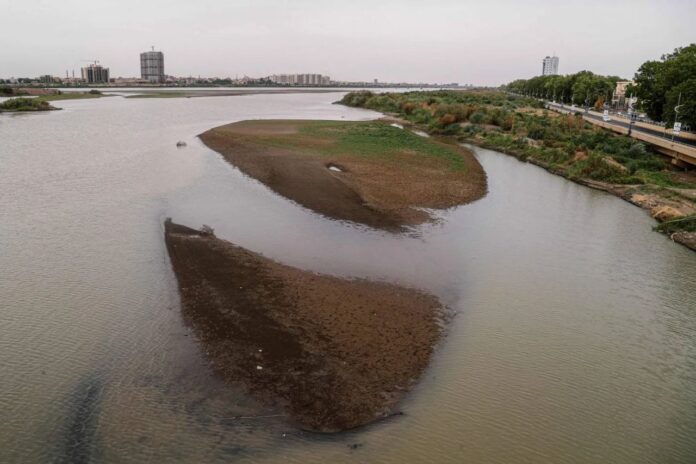
Just south of the capital city of Khartoum, sandbanks and islands that are typically submerged under deep waters by mid-summer now sit fully exposed to the sun. The UN Food and Agriculture Organization (FAO) warns that this growing season is unfolding under unprecedented climate risk, marked by long, severe dry spells and delayed monsoon rains that threaten long-term crop yields across the East African region.
In Gedaref state—a major hub for staple crops such as sorghum and sesame—the delay of crucial seasonal rains has left green fields a dull brown. Local officials and agricultural ministers have urged farmers to delay planting or switch to short-cycle, drought-resistant varieties. However, for many smallholders, the financial math no longer works. Buffeted by high diesel prices to run irrigation pumps and unable to secure affordable fertilizer, many growers have abandoned their crops in the soil, calculating that harvesting them would yield net losses.
With approximately 65 percent of Sudan’s arable land currently out of commission, the agricultural shutdown threatens to push millions deeper into severe food insecurity. As local markets collapse and input costs remain out of reach, veteran farmers who have worked the Nile’s soil for generations voice a shared sentiment: without immediate relief from climate extremes and soaring global commodity prices, Sudan’s primary lifeline will remain dry.