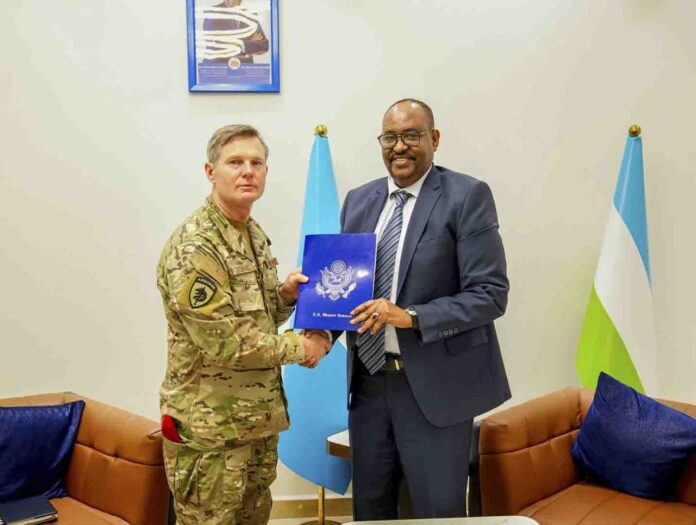
The United States military has bypassed Somalia’s central government in Mogadishu to secure a direct security pact with the northeastern federal member state of Puntland. Regional experts view this maneuver as the definitive proof of a revived American “dual-track” strategy. Washington’s mounting frustration over political gridlock in the capital—which has severely undermined the ongoing national campaign against Al-Shabaab and ISIS-Somalia—has catalyzed this shift.
The landmark agreement was formalized in the port city of Bosaso during high-level meetings between Puntland President Said Abdullahi Deni and a visiting delegation from the U.S. Africa Command (AFRICOM). Headed by Major General Claude Tudor, commander of AFRICOM’s Special Operations component, the American officials met with a full lineup of Puntland ministers, military commanders, and strategic advisors.
President Deni emphasized that the negotiations focused heavily on bolstering bilateral counterterrorism operations and safeguarding critical maritime lanes across the Red Sea and the Gulf of Aden.
At the heart of the newly signed pact is a formal commitment to scale up the U.S. military presence at the strategic Bosaso facility. By reinforcing maritime infrastructure and operational capacity here, Washington positions itself to tackle regional volatility more effectively—including anticipated operations against Yemen’s Houthi movement.
This move mirrors a parallel diplomatic tour completed just days earlier in Hargeisa. The same high-level U.S. delegation met with Somaliland President Abdirahman Mohamed Abdullahi and his cabinet, focusing on identical themes of regional security and maritime defense.
Horn of Africa analysts point out that coordinating independent engagements with semi-autonomous territories outside Mogadishu’s immediate authority signals a calculated diplomatic shift.
“The U.S. military is actively stepping up dual-track diplomacy to deepen cooperation with strategic Somali territories deemed more active in the fight against terrorist groups,” noted Rashid Abdi of Nairobi-based Sahan Research.
This expanding northern footprint is not without internal opposition. Foreign policy organizations, including the Defense Priorities think tank, have openly criticized the strategy. They warn that establishing multiple military and naval installations in Somaliland and Puntland risks dragging the U.S. into protracted local feuds, driving up costs while yielding few strategic dividends. Critics argue that regional flashpoints, such as the Houthi threat, require diplomatic resolution at their roots rather than localized military expansions.
AFRICOM leadership recently cautioned that continued U.S. military investment in Somalia depends entirely on local leaders stepping up to resolve internal political paralysis and assuming complete ownership of their nation’s long-term security.