
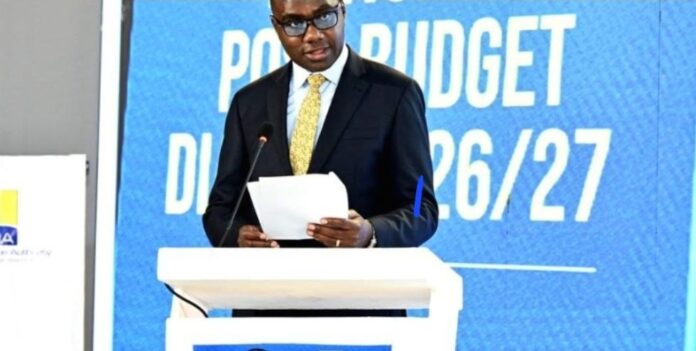
The Ugandan government has set an ambitious target to increase its domestic tax collection to 20% of its Gross Domestic Product (GDP), up from the current 14%, in a strategic move aimed at slashing the country’s heavy reliance on external and domestic borrowing. Speaking at the Uganda Revenue Authority (URA) post-budget breakfast dialogue for the 2026/2027 financial year, Finance Minister Henry Musasizi revealed that the medium-term strategy will heavily depend on aggressive digital transformation, formalizing the informal sector, policy rationalization, and improving client experiences to expand the national tax base.
For the upcoming 2026/2027 fiscal year, the government projects a massive domestic revenue mobilization target of Shs 45.96 trillion, with tax revenues expected to bring in Shs 40.16 trillion. Minister Musasizi emphasized that these locally generated resources are absolutely critical to funding Uganda’s overarching national transformation agenda while preventing the country from slipping into fiscal instability.
The minister framed tax compliance not merely as a legal obligation, but as a patriotic partnership in national development, noting that historically successful economies have always built their growth by financing development using their own domestic resources.
Uganda’s total national budget for the 2026/2027 financial year stands at Shs 84.3 trillion, which exposes a significant funding gap that still requires various sources of financing. Alongside domestic revenue, the budget will be supported by Shs 11.97 trillion in domestic borrowing, Shs 11.27 trillion in external project support, and Shs 13.97 trillion in domestic refinancing. Additionally, the government expects to inject Shs 1.44 trillion from petroleum revenues, Shs 1.22 trillion from budget support grants, and Shs 339 billion collected from local government revenues to fully balance the massive national expenditure.
To ensure these funds deliver maximum economic impact, the government is strictly prioritizing investments under its “ATMS” framework, which targets four high-potential sectors: Agro-industrialization, Tourism development, Mineral-based industrialization, and Science, Technology & Innovation. Minister Musasizi explained that these specific sectors form the bedrock of Uganda’s ambitious Tenfold Growth Strategy, which aims to aggressively scale up the country’s economic output into a USD 500 billion economy by the year 2040.
Ultimately, the government maintains that the true measure of this fiscal strategy will be tangible human development, specifically through job creation, rising household incomes, and poverty reduction across all regions. Backing the minister’s projections, URA Commissioner General John Musinguzi Rujoki strongly reiterated the urgent need for Ugandans to deliver the country from foreign economic dependence. Rujoki expressed firm confidence that ongoing internal tax reforms and sweeping digital upgrades will successfully elevate Uganda’s tax-to-GDP ratio to the targeted 18-20% range.