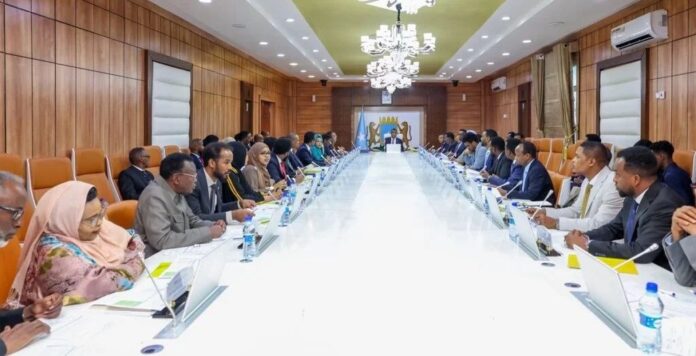
Somalia’s Council of Ministers has officially approved a memorandum of understanding (MoU) with Egypt aimed at strengthening cooperation in maritime transport and ports. The agreement, approved on Thursday, establishes a formal framework for collaboration between Egypt’s Ministry of Transport and Somalia’s Ministry of Ports and Marine Transport.
According to the Somalia National News Agency (SONNA), Somali Minister of Ports and Marine Transport, Mohamed Nur, described the pact as a milestone for bilateral cooperation. Nur emphasized that the agreement will directly support Somalia’s ongoing efforts to modernize its maritime infrastructure, advance its National Transformation Plan (NTP), and elevate its strategic role in regional and global maritime trade.
The development follows closely on the heels of a separate maritime transport and Red Sea port connectivity agreement signed between Egypt and Eritrea during a recent diplomatic visit to Asmara by Egyptian Foreign Minister Badr Abdelatty and Transport Minister Kamel al-Wazir. Following that accord, Cairo and Asmara jointed declared that the governance and security of the Red Sea and the Gulf of Aden should remain the exclusive responsibility of Red Sea littoral states.
Egypt’s dual diplomatic successes in Mogadishu and Asmara signal an accelerating, coordinated push by Cairo to deepen its maritime and security partnerships across the critical waterways of the Horn of Africa. Over the past two years, Egypt has steadily expanded its political, security, and naval footprint in the region, largely driven by shifting alliances and growing geopolitical friction.
The tightening ties between Egypt, Somalia, and Eritrea come amid heightened regional tensions involving Ethiopia. Relationships soured significantly following Ethiopia’s signature of a controversial memorandum of understanding with Somaliland in January 2024. That deal promised Ethiopia commercial and naval access to the Gulf of Aden, a move Mogadishu fiercely rejected as an infringement on its sovereignty and territorial integrity.
In response to Ethiopia’s maritime ambitions, Egypt, Eritrea, and Somalia have forged an increasingly unified front. This alignment was consolidated during a high-profile tripartite summit held in Asmara in October 2024. Presidents Abdel Fattah el-Sisi of Egypt, Isaias Afwerki of Eritrea, and Hassan Sheikh Mohamud of Somalia agreed to deepen cooperation on regional security and border protection. The leaders emphasized an “unequivocal respect for sovereignty,” language widely understood as a direct rebuke to Addis Abeba.
Political analysts have frequently described this emerging alliance as a diplomatic, military, and economic “axis of power” designed to exert pressure on Ethiopia from multiple geographic fronts. This strategy is further complicated by the long-standing, unresolved dispute between Cairo and Addis Abeba over the Grand Ethiopian Renaissance Dam (GERD) on the Blue Nile.
Beyond economic and port connectivity, Egypt’s security involvement on the ground has deepened. Cairo has notably expanded its military footprint within Somalia under the framework of the African Union Support and Stabilization Mission in Somalia (AUSSOM). This involvement includes impending troop deployments, specialized military training programs, direct arms shipments, and planned joint military exercises with Somali forces.
Ethiopia has repeatedly raised the alarm over these developments, warning that the influx of foreign military assets and shifting alliances risk destabilizing the Horn of Africa and upending the regional security balance.
Ethiopia Prime Minister Abiy Ahmed has consistently maintained since late 2023 that Ethiopia’s pursuit of sea access is an existential necessity tied to the country’s long-term economic survival and the needs of its massive population.
While reinforcing the critical nature of the issue, Ethiopian officials continue to reiterate that they intend to pursue their maritime access agenda solely through peaceful dialogue, mutual understanding, and diplomatic means.