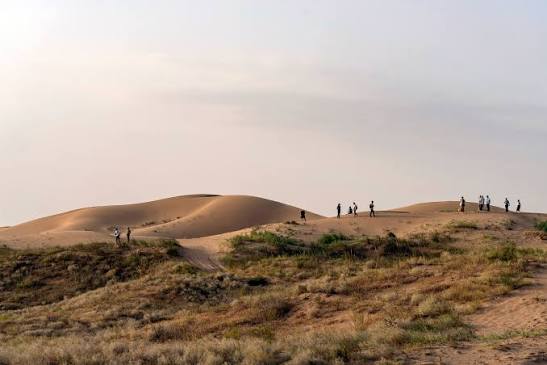
A visit to the Ningxia Baijitan National Nature Reserve, part of a seminar on radio and television program production technologies for the Global South organized by China Broadcasting International Economic and Technical Cooperation Co., Ltd. (CBIC), highlighted China’s long-running effort to turn desert land into a green economic and ecological zone.
Located on the edge of the Mu Us Sandy Land in Ningxia, Baijitan was presented as a model of desertification control built on decades of ecological restoration, scientific sand-control methods and institutional innovation. Seminar materials said the reserve has spent more than 70 years reversing sand expansion through a combination of straw checkerboard barriers, drought-resistant planting and mixed forest development.
The reserve’s “1+4” sand-control system was cited as a key breakthrough. According to the presentation, the model combines straw barriers with four planting methods: rainy-season grass seeding, shrub seeding in holes, nutrient-bag seedlings and spring or autumn tree planting. The materials said the approach has helped raise vegetation coverage to more than 45 percent within three years of planting, despite very low annual rainfall.
Baijitan was also described as a place where ecological protection and economic development go hand in hand. The reserve’s “six-in-one” model links sand fixation, tree-shrub forests, cash orchards, aquaculture, agriculture and eco-tourism, creating income opportunities while strengthening environmental recovery.
The visit further emphasized the reserve’s institutional innovation, including an internal contracting system that gave staff greater ownership over land restoration work. Organizers said the approach helped shift attitudes from compulsory tree planting to active participation in ecological work.
The reserve now hosts hundreds of plant and animal species, and the return of protected wildlife was presented as evidence of a restored food chain. The seminar said Baijitan’s experience offers a practical example of how environmental restoration can support both local development and global cooperation on desertification control.