The Sudanese government has officially begun implementing alternative economic strategies designed to counter the devastating impact of Western sanctions, reliable official sources revealed to the Sudan Tribune. This major policy shift comes in response to previous waves of economic penalties imposed by the United States, which targeted financial networks and business entities closely linked to the Sudanese armed forces and its military chief, General Abdel Fattah al-Burhan.
Fearing a severe expansion of both American and European sanctions as peace negotiations to end the ongoing conflict with the Rapid Support Forces remain bleak, officials in Port Sudan are actively taking defensive economic measures.
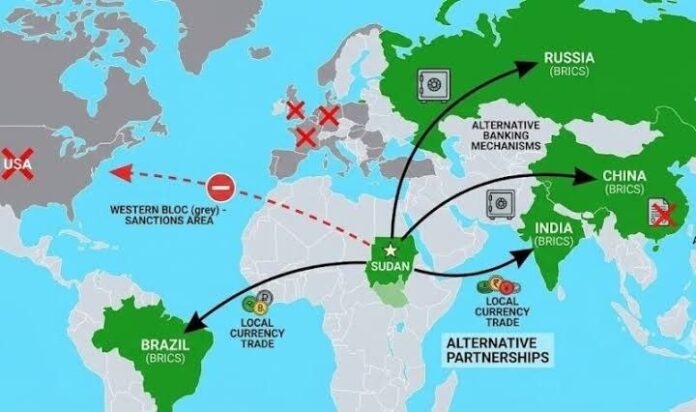
To circumvent the growing restrictions, Sudan’s new approach centers on drastically reducing its systemic reliance on Western financial systems and the dominance of the United States dollar. Official sources state that the newly adopted strategies include the development of alternative cross-border banking mechanisms, the utilization of local currencies to settle international trade, and the cultivation of new geopolitical alliances.
Specifically, Sudanese authorities are looking toward the BRICS economic bloc to secure new economic partnerships, mirroring defensive, counter-coercion tactics previously used by nations like Russia and Iran to evade international banking isolation.
Despite these aggressive shifts toward eastern partnerships, independent experts warn that the immediate structural damage to Sudan’s economy remains profound. Sudanese economics professor Mohamed Imam pointed out that a recent bilateral agreement signed with Beijing to waive nearly $50 million of Sudan’s debt is a drop in the ocean when measured against the country’s staggering total external debt, which currently exceeds $60 billion.
Although China also included a new package of financial and technical grants for future reconstruction projects, the relief does little to offset the deep financial paralysis gripping the nation.
Professor Imam further noted that Sudan officially forfeited a historic opportunity to completely write off more than 80% of its massive sovereign debt through the International Monetary Fund’s Heavily Indebted Poor Countries initiative.
This economic lifeline was permanently derailed by the intense political instability that followed the October 2021 military coup. The coup forced international financial institutions to freeze all financial integration, halting economic normalization paths just as the country was on the verge of major relief. Consequently, the ongoing war has accelerated this isolation into a suffocating global blockade, leaving local commercial networks entirely cut off.
The ongoing conflict has also systematically stripped the national treasury of vital foreign currency reserves by paralyzing the country’s most lucrative export sectors. Vital trade commodities, including gold, gum arabic, and oilseeds, have seen production and export routes completely collapse.
At the same time, international commercial banks have completely pulled out of the region to avoid compliance risks, causing a total freeze in standard banking operations. This external isolation is compounded internally by the rapid collapse of the Sudanese pound, which Imam describes as a direct symptom of institutional fragmentation.