
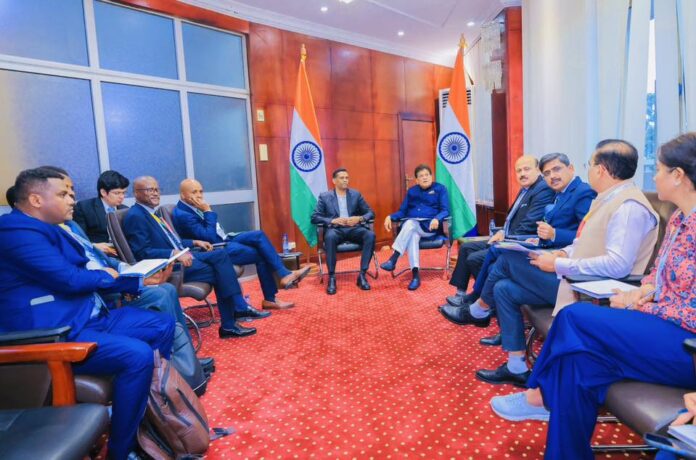
At a time when Ethiopia’s nearly two-decade-long journey to join the World Trade Organization (WTO) has reached its most critical milestone, the country has officially signed a bilateral market access protocol with India in Geneva, Switzerland. This agreement is viewed as a major breakthrough in Addis Ababa’s long-running effort to secure full membership in the global trading body, effectively advancing the negotiation process into its final phase.
The protocol was signed during a ceremony yesterday in Geneva by Ambassador Tsegab Kebebew, Ethiopia’s Permanent Representative to the United Nations Office and other international organizations in Geneva, and Senthil Pandian, India’s Permanent Representative to the WTO.
Both sides stated that the market access agreement reflects their shared commitment to jointly fostering a transparent, rules-based, and development-oriented multilateral trading system. The protocol details the mutually agreed market access commitments and privileges regarding goods and services, forming a core component of the broader accession package Ethiopia must complete to secure membership.
Formally launched in 2003 with the establishment of its WTO Working Party, Ethiopia’s accession process has evolved into one of the longest-running negotiations in the organization’s history.
Although the process faced repeated pauses, an expanding set of technical requirements, and policy revisions over the years, the government in Addis Ababa has injected strong new momentum into the talks recently. Today, WTO member states acknowledge that the process has shifted away from a foundational review of Ethiopia’s trade and visa regimes into a decisive phase focused on finalizing concrete commitments.
This progress has been driven by intensified bilateral negotiations over tariff bindings and services liberalization. Addis Ababa has submitted extensive documentation to the Geneva-based Working Party, which has reviewed hundreds of legal and regulatory reforms covering customs procedures, investment laws, and sectoral policies.
The pace of bilateral market access deals has accelerated over the past few months, and this latest agreement with India adds significant political and economic weight to the trajectory. Since India is a key trading partner for Ethiopia, locking in terms with New Delhi is expected to pave the way for a smooth conclusion to the remaining bilateral negotiations.
Alongside external diplomacy, Ethiopia has pursued extensive domestic reforms aimed at aligning its economy with WTO principles. These initiatives include gradual changes in trade facilitation, customs administration, investment policy, and the opening up of strategic service sectors—such as finance and telecommunications—to foreign competition. WTO officials characterize this phase as one where legal alignment and negotiated commitments are being brought together ahead of compiling the final Draft Working Party Report.
Moving forward, Ethiopia is expected to focus on completing its remaining bilateral agreements, resolving outstanding technical questions raised by member states, and finalizing its Draft Working Party Report. Once these steps are completed, the full accession package will be submitted to the WTO General Council for approval by the membership, marking the final legal hurdle before historic membership is officially granted.