Uganda has officially announced its transition to the high-level “Implementation Phase” after completing the core infrastructure construction process. Government and industry regulators have confirmed that the journey to extract First Oil in the second half of 2026 is proceeding without any obstacles.
This statement was issued on the eve of the 11th Annual Oil and Gas Convention (OGC 2026), scheduled to take place from April 28–29 at the Speke Resort Munyonyo. Held under the theme “First Oil: Delivering the Promise, Shaping the Future, “this major summit is expected to mark a historic turning point as the country shifts from a decade-long construction phase to operations and actual production.
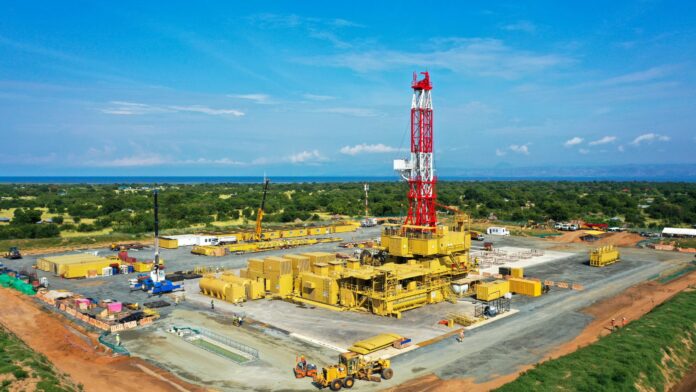
According to the latest data provided by the Petroleum Authority of Uganda (PAU) and joint-venture partners, the infrastructure landscape in the Albertine Graben has been completely transformed. The Kingfisher Development, led by CNOOC, is now 99% complete.
Civil works have been finalized, and the oil feeder pipeline construction has reached 99.4%. Currently, the focus is on final testing procedures and ensuring the efficiency of pumps and generators.
The Tilenga Project, led by TotalEnergies, has surpassed its planned targets. While 170 oil wells were originally scheduled for drilling, 198 wells have been completedso far, ensuring a sufficient oil supply once production begins.
Similarly, construction of the East African Crude Oil Pipeline (EACOP)—a 1,443-kilometer pipeline stretching to the Tanzanian coast—has reached 83%. With all pipes delivered to the site and the marine terminal in Tanga at 88% completion, the first oil exports are expected to commence in October 2026.
Gloria Sebikari, the Authority’s Corporate Affairs Manager, stated: “The question of whether Uganda can produce oil has now been answered. The wells are drilled, targets have been met, and contractors are working day and night. We are now preparing to manage a world-class petroleum sector.”
This transition is currently providing significant benefits to the country’s economy. Sector data shows that nearly $2 billion has been awarded in contracts to local Ugandan companies thus far. Beyond creating over 80,000 direct and indirect job opportunities, this investment has enabled more than 7,000 Ugandans to receive specialized training in petroleum engineering and safety.
Humphrey Asiimwe, CEO of the Uganda Chamber of Energy and Minerals (UCEM), noted that this success demonstrates the country’s institutional discipline and political commitment, adding that the focus has now shifted toward maintenance and operations, which will create stable business opportunities for the next 25 to 30 years.
At the upcoming OGC 2026 conference, discussions will center on three major future milestones. First, construction of the $4 billion domestic oil refinery is accelerating, with the Final Investment Decision (FID) expected in July 2026.