Egypt has officially announced its decision to provide comprehensive technical support and feasibility studies for Eritrea’s industrial and infrastructure development. This move is regarded as a major step toward strengthening regional economic integration.
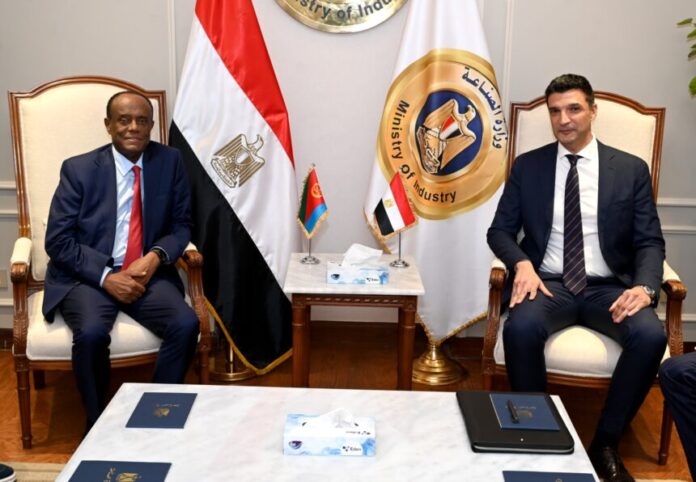
The agreement was reached during a meeting in Cairo between Egypt’s Minister of Industry, Khaled Hashem, and a high-level delegation led by Hagos Gebrehiwet, Economic Adviser to the Eritrean President.
This partnership is described as a “new chapter” in Red Sea diplomacy, signaling Egypt’s desire to expand its successful industrial model to neighboring Horn of Africa nations. Minister Hashem stated that this cooperation is not merely a diplomatic gesture but a strategic decision aimed at aligning Egypt’s industrial expertise with Eritrea’s untapped natural resources and strategic maritime location.
A core pillar of the agreement involves the Egyptian Ministry of Industry conducting rigorous feasibility studies for various priority projects in Eritrea. These studies will serve as a roadmap for establishing strategic industries designed to satisfy domestic demand and produce a surplus for export to neighboring East African markets.
Minister Hashem noted that Egypt is ready to share its local manufacturing strategies and deploy technical experts to help build an industrial infrastructure capable of attracting international investment and fostering long-term economic resilience.
During the discussions, several critical sectors were identified for immediate collaboration. These include agro-industries, where Egyptian processing technology will be used to add value to Eritrean agricultural products, as well as mining and fisheries, leveraging Egypt’s experience in management and extraction to utilize Eritrea’s vast coastline and mineral deposits.
Additionally, there is a focus on renewable energy, particularly solar power infrastructure, to secure energy supplies for industrial zones.Recognizing that infrastructure is only effective when managed by a skilled workforce, both countries agreed to cooperate on human resource development.
Egypt will support the establishment of vocational and technical training centers in Eritrea to ensure that as new factories and power plants are built, they are operated by highly trained Eritrean technicians.
To ensure the success of these industrial projects, the delegation also addressed obstacles to trade exchange. This includes modernizing institutional frameworks, making trade systems and product quality standards internationally competitive, and resolving financial and transport challenges between the two nations.
Hagos Gebrehiwet affirmed that Eritrea views Egypt as a “key strategic partner” and emphasized that the visit to Cairo aimed to develop a practical roadmap to transform diplomatic ties into tangible economic results. As part of this plan, the Egyptian-Eritrean Joint Business Council is expected to be established soon, paving the way for private investors to participate directly under the protection and technical support of both governments.