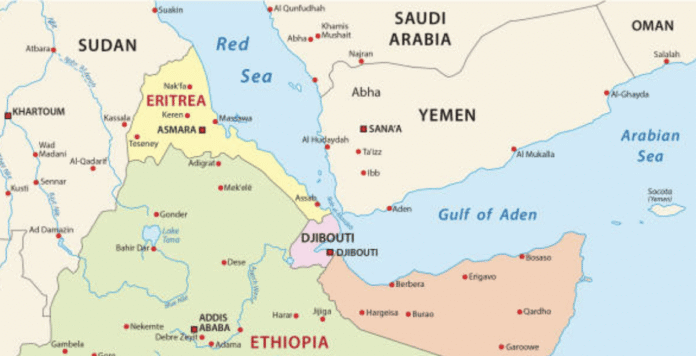
On April 10, 2026, President Ismaïl Omar Guelleh began his sixth term in office after securing 97.81% of the vote. To an outside observer, such a result might suggest absolute national harmony. However, within this small nation situated on the coast of the Red Sea in Southeast Africa, a complex paradox emerges: while Djibouti serves as the location for the world’s most vital military bases, it simultaneously remains a country with a fragile economy burdened by structural weaknesses.
With a landmass of less than 25,000 square kilometers, Djibouti has achieved a geopolitical feat unmatched by any other nation. By transforming its geographical location into a business, it leases the gateway to the Bab el-Mandeb—through which 10% of global trade passes—to major world powers. Today, Djibouti is the only place on Earth where the military bases of rival superpowers stand side-by-side, within sight of one another.
The engine of Djibouti’s economy is not driven by sectors like manufacturing or agriculture, but rather by “strategic rent” derived from foreign military bases. The United States pays approximately $65 million annually for Camp Lemonnier, its only permanent military base in Africa. France, the former colonial power, contributes over $35 million. These figures are bolstered by payments from Japan, Italy, and notably China, which opened its first overseas military base there in 2017.
In total, these direct leases generate between $150 million and $200 million annually for an economy with a Gross Domestic Product (GDP) of roughly $4 billion. As economist Omar M. Elmi explains: “This is a unique model; Djibouti has turned its land into a service. However, this income is a double-edged sword because it makes the country dependent on external geopolitical conditions rather than internal productivity.”
The very geography that has made Djibouti prosperous has, conversely, left it vulnerable to international security crises. Located just 30 kilometers by sea from Yemen, Djibouti is on the front lines of the security crisis in the Red Sea. As Houthi rebels continue to disrupt international shipping, Djibouti’s ports—the nation’s lifeblood—remain under significant strain.
While the presence of global naval powers provides a sense of security, it also risks turning the country into a friction zone for the rivalry between the United States and China. The physical proximity of these competing powers has created a tension that the Djiboutian government must manage with great diplomatic skill.
Perhaps the greatest “fault line” is the country’s internal politics. President Guelleh has led the nation since 1999, establishing a centralized system where dissenting voices are rarely heard. While this provides a sense of stability for foreign partners, the lack of a clear succession plan creates uncertainty for the future.
As the “post-Guelleh” era approaches, questions arise as to whether the country’s institutions can stand without their primary architect. If the economy cannot be modernized to create jobs for the youth, this “strategic giant” may find that its greatest threat comes not from the sea, but from within.
For now, Djibouti continues to serve as an anchor of stability in a turbulent region, hosting thousands of refugees and the world’s most powerful militaries. But as global geopolitical fault lines widen, the cost of maintaining this delicate balance is higher than ever.