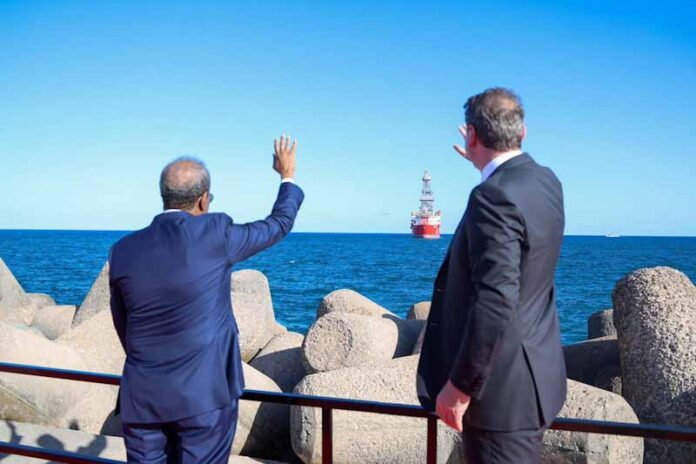
On Friday, President Hassan Sheikh Mohamud, alongside senior federal officials and international diplomats, gathered at the Port of Mogadishu for a grand ceremony to welcome the Turkish oil drillship Çağrı Bey.
The arrival of this state-of-the-art vessel marks the formal launch of Somalia’s first-ever deep-sea oil exploration campaign in its history. This milestone is expected to transform Somalia—currently one of the world’s most fragile economies—into a regional energy hub.
President Mohamud, accompanied by Turkey’s Minister of Energy and Natural Resources, Alparslan Bayraktar, toured the seventh-generation drillship, which is capable of operating in extremely deep waters. In his speech to the gathered public, the President described the ship’s arrival as a victory that overcomes the decades of crisis the country has endured.
“The anchoring of the Çağrı Bey has opened a new chapter in our efforts to boost economic growth and responsibly utilize our natural resources,” the President stated. “For too long, Somalia was known for its challenges; today is the day we introduce ourselves through our capabilities and potential.”
The operation, taking place at the Curad-1 oil well located 372 kilometers off the coast of Galmudug, is not merely a symbolic gesture but a feat of modern engineering. Technical data indicates the well will reach a total depth of 7,500 meters, drilling 4,005 meters below the seabed in waters nearly 3,500 meters deep.
To ensure the safety of the project in a region where maritime security remains a concern, Turkish Navy frigates and support ships will provide year-round protection around the drilling site.
Despite the celebratory tone of the inauguration, the project is facing significant criticism from civil society and political opposition. Critics point out that the energy agreement signed between Mogadishu and Ankara in 2024 lacks transparency. While the government promises shared prosperity, the specific revenue-sharing ratios and the period for Turkey to recover its costs—rumored by some to be as high as 90% of initial production—have not been made public.
For many Somalis, the President’s warning from a decade ago remains fresh in their minds. During his first term, Mohamud famously remarked that Somalia lacked the institutional “muscle” to manage oil wealth without triggering internal conflict. On Friday, however, he addressed these concerns by pledging that oil revenues would be managed with “absolute fairness and transparency” to support national reconstruction and basic services.