

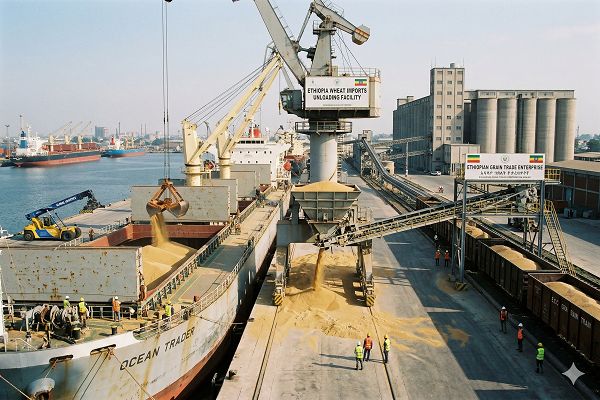
Ethiopia’s agricultural sector is navigating a complex paradox of record-breaking production and severe market strain. According to the latest Grain and Feed Annual report from the USDA Foreign Agricultural Service, while the nation is on track for a historic wheat harvest, structural economic shifts and high domestic costs have left the country increasingly reliant on grain shipments from the Black Sea region to stabilize its volatile markets.
For the 2026/27 marketing year, Ethiopia’s wheat production is forecast at a record 7.0 million metric tons (MT), representing an eight percent increase over the previous year. This growth is largely attributed to the government’s National Wheat Flagship Program, which has aggressively expanded irrigated wheat cultivation in lowland areas.
The surge is further supported by the broader adoption of improved seed varieties and the continued development of “cluster farming” and mechanization, aiming to link smallholder and commercial producers directly to domestic millers.
Other major grains are also seeing gains, with corn forecast at 10.5 million MT due to a 90 percent adoption rate of hybrid seeds, while sorghum and barley are projected to rise to 4.1 million MT and 2.5 million MT respectively, supported by favorable weather and industrial investment.
Despite these record harvests, local wheat supplies remain tight, and demand continues to outpace domestic growth, leading to a forecast of 1.4 million MT in commercial wheat imports for the coming year.
In a striking market trend, imported wheat from Russia, Ukraine, and Romania has become a vital price stabilizer, accounting for 93 percent of wheat grain imports. As of January 2026, imported wheat was priced at approximately $420 per MT, which is roughly $45 lower than locally produced wheat.
Industry analysts note that without these Black Sea shipments, domestic wheat prices could have soared even higher, as private traders now play a central role in using their own foreign exchange to secure bulk shipments.
The primary driver of high domestic grain prices is a series of seismic macroeconomic reforms, specifically the shift to a market-based exchange rate in July 2024. By February 2026, the Ethiopian Birr had lost approximately 107 percent of its value against the U.S. dollar, reaching an exchange rate of 155 ETB per USD. This devaluation has sent shockwaves through the agricultural supply chain, causing imported fertilizer prices to surge by 60 percent and gasoline prices to rise by 56 percent.
Consequently, the cost of transporting grain has spiked, and wheat retail prices recorded a 28 percent increase in a single year, climbing to ETB 8,250 per 100kg.
This economic pressure is forcing millions of urban households to adapt their diets, as teff remains the most expensive staple at more than double the price of corn.
To manage costs, many families are mixing teff with more affordable grains like sorghum or maize to prepare traditional injera, while also shifting toward processed wheat products like bread and pasta for their convenience.
Amidst these changes, the government has implemented a mandatory wheat flour fortification policy as of August 2024, requiring all flour to be enriched with iron, zinc, and B-complex vitamins to address nutritional deficiencies.
Currently, Ethiopia’s 500 milling factories operate at only 45 to 50 percent capacity due to inconsistent wheat supplies and foreign exchange shortages. However, several critical challenges threaten long-term stability and food security.
Continued currency depreciation makes essential inputs like fertilizers and seeds prohibitively expensive for smallholder farmers. Additionally, the 2025/26 season was marred by erratic rainfall, including localized droughts in the Hararghe regions and flooding in South Ethiopia, which resulted in total crop failures for some communities.