
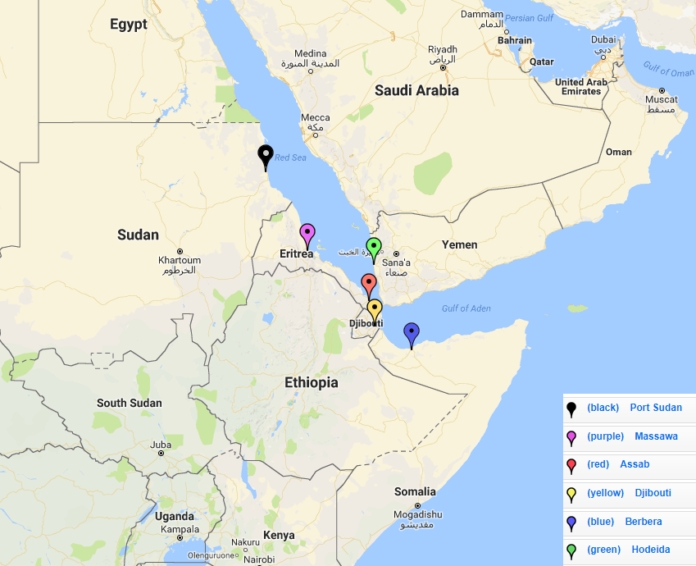
For decades, the story of East African logistics was defined by a single, unbreakable link. Following Eritrea’s independence in 1993, the landlocked giant Ethiopia and coastal Djibouti maintained a relationship born of mutual necessity. However, as 2026 progresses, this “exclusive bond” is being tested by an emerging “Strategic Triangle.” From the Berbera Corridor to the shores of the Red Sea, the intense scramble for port diversification is fundamentally altering the flow of goods, capital, and political influence in East Africa.
For the past thirty years, Djibouti has served as Ethiopia’s “lungs.” Currently, over 90% of Ethiopia’s import-export trade passes through the Djibouti-Addis Ababa corridor. This partnership transformed Djibouti into a global logistics hub, bolstered by the Doraleh Container Terminal and the Chinese-funded Addis Ababa-Djibouti railway. However, for a nation of over 120 million people with aspirations for continuous industrial growth, relying on a single exit point has long been viewed as a strategic vulnerability. Today, this exclusivity is giving way to a variety of options. Driven by a desire to insulate itself from regional instability and secure competitive pricing, Addis Ababa is actively seeking alternative “lungs.”
The primary challenger to the status quo is the Port of Berbera in Somaliland. Backed by massive investment from the UAE-based logistics giant DP World, Berbera has evolved from a simple regional port into a modern maritime gateway. This modernization extends beyond cranes and berths; the “Berbera Corridor” highway, stretching from the coast to the Ethiopian border town of Tog Wajale, plays a critical role. Ethiopia’s previous acquisition of a 19% stake in the port project sent a clear message: Berbera is no longer just a secondary option, but a major competitor.
The Memorandum of Understanding (MoU) signed between Ethiopia and Somaliland in January 2024—aimed at securing a sea outlet in exchange for recognition—sent shockwaves through the region. While diplomatic tensions persist, the economic reality is clear: Ethiopia is determined to secure multiple maritime outlets to guarantee its economic sovereignty.
The race for port supremacy is inextricably linked to shifting diplomatic alignments. Recognizing the threat to its primary revenue source, Djibouti has strengthened its ties with the Federal Government of Somalia. This has led to a “diplomatic chill” between Djibouti and Somaliland, evidenced by Djibouti’s recent restrictions on travel documents used by Somaliland officials. Furthermore, the intervention of Middle Eastern powers has complicated the competitive landscape. Given the UAE’s heavy involvement in Berbera and its strained history with Djibouti (following the 2018 termination of the Doraleh agreement), every new pier built in Somaliland is viewed as an arena of competition between Abu Dhabi and other regional actors.
The logistics shift also extends southward. Kenya’s Lamu Port (part of the LAPSSET Corridor) remains a high-potential alternative in the region. Although its progress has been slower than the Berbera-Ethiopia route, Kenya’s potential to capture the South Ethiopian market remains a long-term threat to the northern corridors. Industry analysts suggest that if Ethiopia successfully integrates the Lamu route, it will create a “logistics tripod,” allowing the government to leverage competition between Djibouti, Berbera, and Lamu to reduce transit fees and improve efficiency.
The defining question of 2026 is whether this competition will lead to an integrated East Africa or a fragmented one. One regional economist notes, “We are witnessing the birth of a competitive market for maritime services. In the short term, this creates friction. But in the long run, if these ports find their specific niches—for instance, one focusing on bulk commodities like fertilizer and grain while another focuses on containerized tech—the entire region will benefit from lower costs of living and trade.”
However, the risks are equally high. Port deals, especially those involving contested territories or unilateral recognition, have the potential to create new security threats in the Red Sea, one of the world’s most critical trade routes. As the “Strategic Triangle” matures, the primary indicators for determining the winner of this logistics race will be infrastructure efficiency, digital integration to reduce “invisible costs” through unified customs systems, and political stability—specifically Ethiopia’s ability to balance its economic needs with Somalia’s territorial integrity and Djibouti’s strategic concerns.
The logistics map of East Africa is no longer a straight line from Addis Ababa to Djibouti City. Instead, it has become a complex web of interests and opportunities. For Ethiopia, the goal is to secure a “multi-port” future. For Djibouti, the challenge is to maintain its leadership through innovation. For Somaliland, Berbera is their key instrument for reaching the international stage. In this high-stakes environment, only one thing is certain: the era of the single gatekeeper is over. East Africa is opening up, and the race to the sea has only just begun.