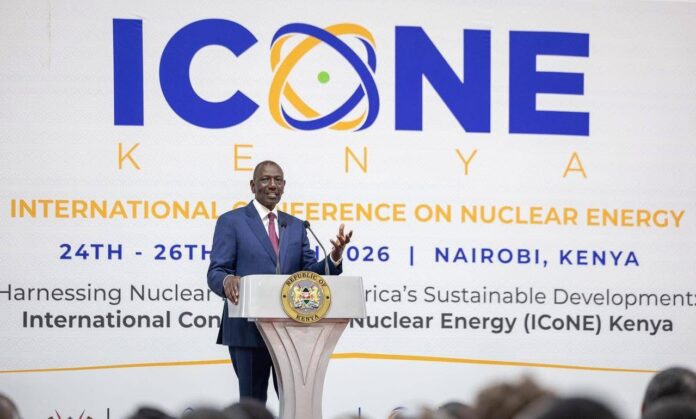
In a historic move aimed at transforming Kenya’s energy landscape and establishing the nation as a regional industrial hub, President William Ruto has officially announced that Kenya will begin the construction of its first nuclear power plant in Siaya County in 2027.
This landmark declaration was made on Wednesday, March 25, 2026, during the opening of the International Conference on Nuclear Energy (ICoNE) at the Kenyatta International Convention Centre (KICC) in Nairobi. The massive project, boasting a capacity of 2,000 megawatts (MW), is expected to be fully operational and commissioned by 2034.
Addressing an audience of international nuclear experts, regulators, and African leaders, President Ruto described the decision as a “deliberate and strategic” necessity for the nation’s growth. He revealed that the government is committed to scaling up Kenya’s current electricity supply from 3,300MW to at least 10,000MW over the next five to seven years.
The President emphasized that energy is the lifeblood of industrial expansion, innovation, and economic transition, noting that diversifying energy sources is essential to powering factories and ensuring prosperity for future generations.
Out of the targeted 10,000MW, the government plans for 3,000MW to be generated from nuclear sources, starting with the multi-billion shilling facility in Siaya. This project is anticipated to create a significant economic surge for both the local region and the country at large.
At the height of its construction, the Siaya plant is projected to provide employment for between 5,000 and 12,000 citizens, ranging from manual labor to highly specialized nuclear engineering roles.
To ensure Kenyans are the primary beneficiaries of these opportunities, President Ruto underscored that the government will invest heavily in local technical and vocational education. Beyond direct job creation, the “nuclear era” is set to drastically reduce electricity costs, with tariffs expected to drop to between 4 and 5.5 US cents per unit—a sharp decline from the current average of 9 cents.
Furthermore, the plan will trigger extensive infrastructure development in the Nyanza region, including the expansion of all-weather roads, water supply systems, and modern healthcare facilities.
Addressing the common “fear and uncertainty” associated with the word ‘nuclear,’ the President urged the public to focus on scientific evidence. He highlighted that nuclear energy is one of the cleanest power sources available, producing virtually no greenhouse gas emissions and serving as a powerful ally in the global fight against climate change.